Answer Short Question
June 2, 2024 2025-08-17 13:11Answer Short Question
Reading Time: 10 minutesPart 1: Speaking
ANSWER SHORT QUESTION
Made Easy
-
Time to give your response 10 seconds
-
Type of Recording: audio only, single sentence
-
Number of these tasks: 5 - 6
Answer short question tests your ability to answer a question using the right vocabulary.
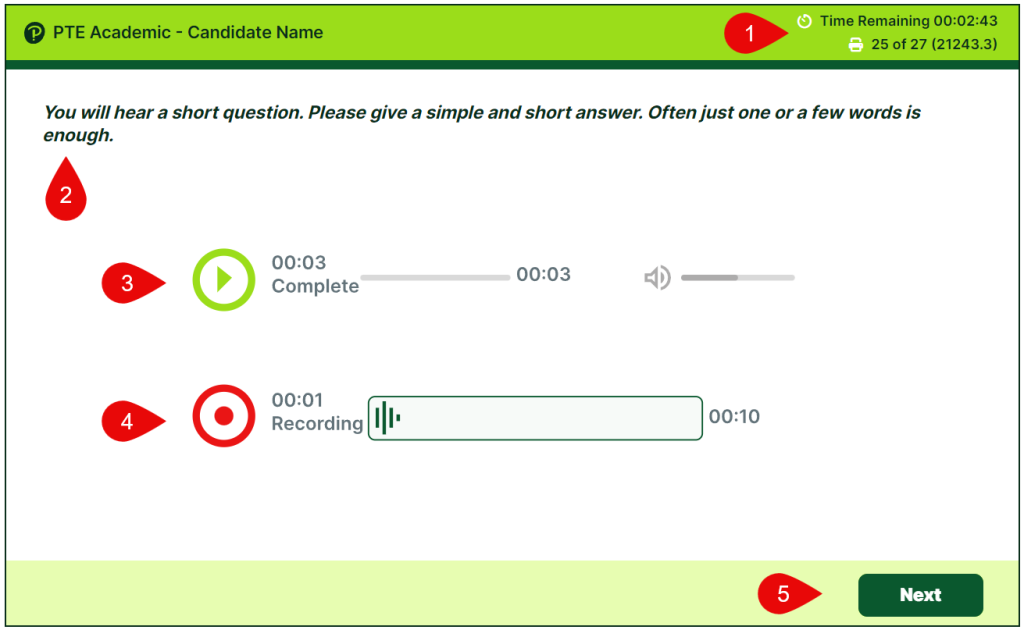
- You will see instructions, an audio status box and a recording status box.
- You will hear a question.
- You should give a short answer (just one or a few words) using the microphone.
- This task tests your listening and speaking skills, as well as your vocabulary.
- The timer shows the time left for all tasks in this part of the test.
- Read the task instructions.
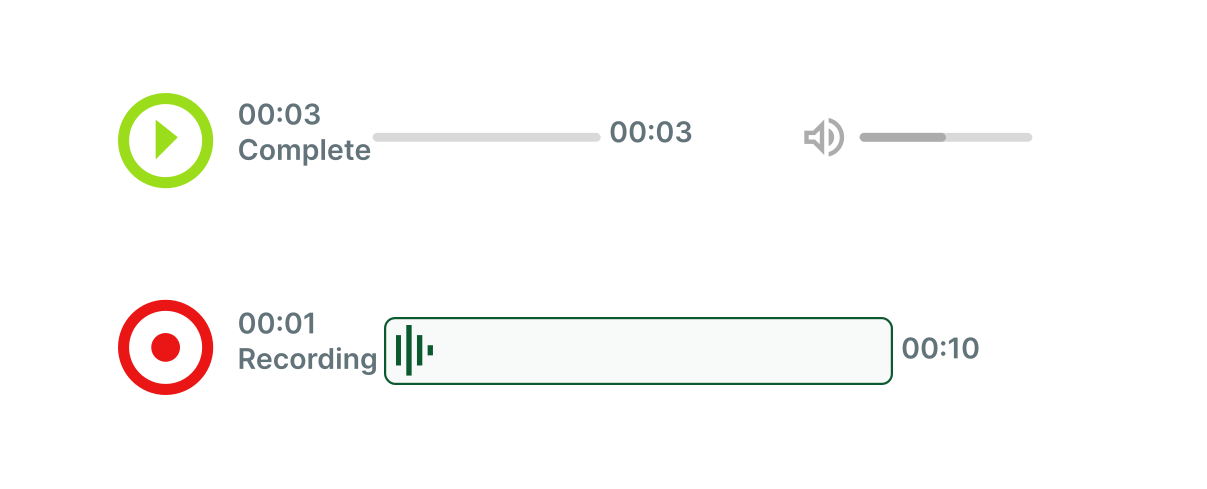
- The audio status box counts down from three seconds to zero. Then you hear a question, followed by a one-second pause.
- The recording status box changes to ‘Recording’. Start speaking when the bar begins moving. Give your answer into the microphone (just one or a few words is fine). When the bar reaches the end (after 10 seconds), or when you’ve stopped speaking for three seconds, the microphone switches off and the recording status box changes to ‘Completed’.
- Click ‘Next’ to go to the next task.
- PTE Academic - Candidate Name
- Time Remaining 00:02:43
- 25 of 27 (21243.3)
You will hear a short question. Please give a simple and short answer. Often just one or a few words is enough.
Answer Short Question Tests One Skill
-
Listeningup to 5 points
- Understanding detailed information
- Understanding academic vocabulary
- Inferring the meaning of unfamiliar words
Top Strategies for Success in Answer Short Question
- Before The Test
When getting ready for this task type, there are lots of things to keep in mind.
A good way to expand your vocabulary is by using diagrams. Use these to build up your knowledge of word forms. A thesaurus and dictionary can help you to add more words.
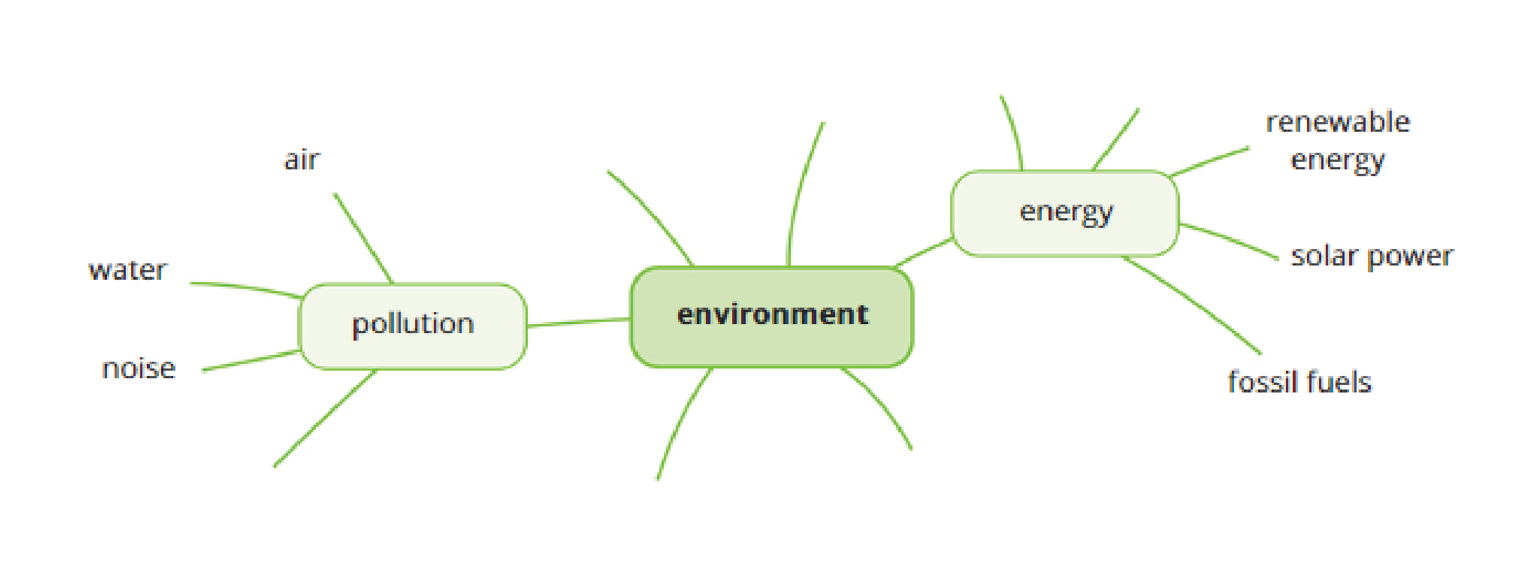
Start with a common word, (e.g. pollution), and put this at the top of your diagram. You can then show the different parts of speech of this word, along with example sentences.
You can also create diagrams to extend your vocabulary on a topic. Here is an example, on the topic of the environment.
-
Practice TipsFollow To Succeed
Learn academic vocabulary as it really helps with these tasks! Research shows that an excellent way to improve your vocabulary is to do lots of reading on a range of different topics.
While reading, note down new words you find in a vocabulary notebook. Record other information about the word, too (e.g. whether it’s a noun, verb or adjective, countable or uncountable, etc.) Include example sentences in your notebook.
Focus on learning the right vocabulary. Don’t spend too much time on technical words that you might never use. Focus on broadening your vocabulary in general across a lot of topics and learning words that might be used frequently in an academic context.
Record the pronunciation of new words. Use a dictionary that has a recording of the words and make sure you know where the stress is placed. This may change between noun, verb and adjective forms. For example: extrovert, extroversion, extroverted.
Don’t worry about your general knowledge. These questions test your English, not your knowledge. They can be answered just by using the general knowledge that most people have.
Find question lists. Practise answering your own questions or by using the questions on the Online Question Bank
- During The Test
BEFORE LISTENING
You only have three seconds before you hear the question, Make sure you’re prepared and ready to answer the question
WHILE LISTENING
Listen carefully to the question and decide the type of information it is asking for. For example, should your answer be a noun, a verb or an adjective?
Pay careful attention to stressed words in the questions. The stressed words usually carry the main meaning.
WHILE ANSWERING
◾ There is no tone to indicate when the microphone opens, so just start speaking as soon as the status changes to ‘Recording’.
◾ Ignore other people in the room. Don’t let their speaking distract you.
◾ Speak normally– not too quiet, too loud, too fast or too slow.
◾ You only need to answer with one word or a short phrase.
◾ Try not to think too much about your answer to these tasks. If you need thinking time, just say something. The microphone will stay open, but will close after three seconds of silence or after 10 seconds in total, so be quick!
◾ Try not to answer with words from the question.
◾ If you make a mistake, stay calm and correct yourself. In Answer short question tasks, wrong answers are ignored and you will not lose points for them, so you can keep trying until you give a correct answer or run out of time. This is different from some of the other speaking tasks.
◾ If you can’t think of the answer, guess. There is no penalty if you are wrong, and you might be right!
◾ Similarly, if you think of a better idea after your first answer, give it quickly, before the microphone closes.
Remember, What To Do What Not To Do In Answer Short Question
- You start speaking straight after the question is finished.
- You don’t wait too long before you answer. The microphone activates one second after the question finishes.
- You think about the question as you hear it and form your answer.
- You don’t take notes. There is no time to review them.
- You speak clearly.
- You don’t speak too quietly, loudly, quickly or slowly. Your pronunciation is not scored in these tasks, but your answer must be clear for the system to recognise your voice.
- You keep guessing if you are unsure because you might get some clue.
- You don’t stay silent. Making a guess has some chance of being correct and there is no penalty for saying something incorrect.
- You keep concentrating on the questions.
- You don’t relax yet. You have 5 – 6 of these tasks in the test. You can pause briefly after the last one.
- You speak naturally.
- You don’t worry about your accent. As long as your answer is clear, any accent is accepted.
Practice Now With Your Trainer
Practise this task here, if you want to try Answer Short Question without a time limit. Think about the strategies mentioned above. Then follow the task instructions and record your response on your mobile phone or other device.
- PTE Academic - Candidate Name
- Time Remaining 00:02:43
- 25 of 27 (21243.3)
You will hear a short question. Please give a simple and short answer. Often just one or a few words is enough.
Reflecting on your practice
1. Play back and listen to your response. Use the checklist below to decide what you did well and what you need to practise more. Set aside time to work on each area that you want to improve.
- I listened for the type of information the question was asking for.
- I spoke normally – not too loud, not too quiet, not too fast, not too slow.
- I understood the question’s overall meaning well.
- I didn’t pause for too long.
- I understood the vocabulary in the question well.
- I quickly tried again if I made a mistake.
- I responded as soon as the question finished.
- I pronounced the answer clearly.
- I made guesses if I didn’t know the answer straight away.
2. Listen to a model answer for this task. Compare it to your own response. What are the differences? Are you happy with your response? What could you improve?
Anatomy
Common Mistakes Problems Errors In Answer Short Question
Points To Remember Speaking Tasks
Some people speak quietly because they don’t want to disturb other people during the test. Don’t do this – speak normally and imagine the other people aren’t there. If everything was OK during the microphone check, your natural speaking voice should be fine.
Don’t click ‘Next’ too soon. Only move on to the next task when you are sure you are finished with the current one. You can’t go back to these tasks to try again.
Most Repeated Answer Short Question Questions in 2025
1.
Seasons
2.
Body language / sign language
3.
Melt
4.
Budget
5.
Sunscreen
6.
Graffiti
Quick Tips Strategies For Better Score!
You hear a short question and then the recording status box will change to recording.
Start your answer as soon as this happens. If you wait for more than three seconds, the recording will stop and the item status will change to 'completed', which means that you have lost your chance to give your answer.

When you have started talking, don't stop for more than a second or two until you have finished. If you stop for three seconds whilst speaking, the recording status will change to 'completed' even if you haven't finished, and you won't be able to continue answering.
If the status changes to 'completed', you have to click 'Next' to move on to the next item. This also applies to speaking item types Read aloud, Repeat Sentence, Describe Image and Re-tell Lecture.

The instructions for this item type tell you how to answer the question:

There is no point in saying more than you need to say. Marks are awarded for a short, accurate answer. There are no extra marks for additional words.
For example, for this question: 'What type of periodical is published on a daily basis?', both these answers would score the same marks:

Your response for Answer Short Question is judged on your ability to understand a question presented in a recording and provide a brief and accurate response. Your response is scored as either correct or incorrect based on how appropriate the words in your response are. No credit is given for no response or an incorrect response.
Note
• This question type affects the scoring of the following: listening, speaking and vocabulary.
• Your writing skills are not tested by this question type, and your reading skills are only used to read the instructions.
• For more information download the Score Guide.
Answer Short Question Task Worksheet
In this worksheet, you are going to look at strategies for preparing for and practising the Answer short question task.
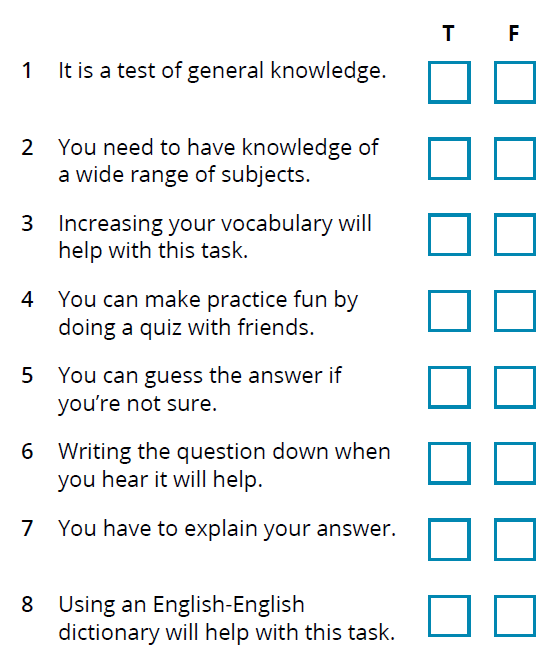
1. It is important to build up your confidence before attempting this task. Read the statements about the Answer short question task. Are the sentences true (T) or false (F)?
2. You need to be familiar with the equipment and the set-up of the task, so make sure you practise before. Chose the correct option, a, b or c.
1. What will you see on the screen?
a instructions, audio status box and image
b recording status box and audio status box
c instructions, audio status box and recording status box
2. You should __________________
a change the position of the microphone for each question.
b keep the microphone in the position it was in for the microphone test.
c bring the microphone very close to your mouth if the exam room is noisy during the task.
3. If you click Next too soon, you
a can’t go back.
b can start again.
c will score zero.
The goal of the task is to answer a question in one or a few words. Your response must be an appropriate answer, so it is important to listen for the question word, for example, How, How many, What or Where. The question word tells you what type of answer you need to give. For example, if you hear When … ?, the answer is likely to be a time, day, month, year, etc.
3.1. Match the question word(s) with two answers from the box.

What?
______________________________________________________
______________________________________________________
When?
______________________________________________________
______________________________________________________
Where?
______________________________________________________
______________________________________________________
How many?
______________________________________________________
______________________________________________________
How often?
______________________________________________________
______________________________________________________
3.2.
Listen to the recording. The fi rst time you listen, write down the question word(s) you hear:
1. ______________________________________________
2. ______________________________________________
3. ______________________________________________
4. ______________________________________________
3.3.
Listen again and try to answer the questions as quickly as you can. Check your answers with trainer.
In this task, it is important to listen for key words that will give you clues to the answer.
4.1. Read the questions and underline the key words. Then answer the questions. Check your answers in the answer key.
1. Which medical professional do you visit if you have a problem with your eyes?
ophthalmologist/optician
2. What is a long, thin, man-made stretch of water which boats use to travel along?
3. What is a very large sea mammal which breathes out through a hole in the top of its head?
4. What is a type of aircraft without wings that can take off vertically?
5. What is a building with scientific equipment for doing experiments?
4.2. Read the questions and answers. Complete the questions with the missing key words.
1. Q: How many ____________ does a square have?
A: four
2. Q: What do we call the ____________ in our head that we use to ____________ ?
A: brain
3. Q: What ____________ would you use to chop ____________ ?
A: an axe
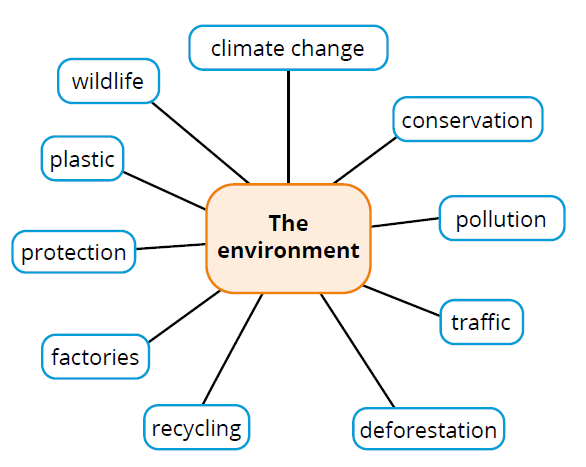
5.1. Building your vocabulary is a good way to prepare for the Answer short question task. Look at the spidergram around the subject area of the environment. Use an English-English dictionary to check the meaning of any words you don’t know.
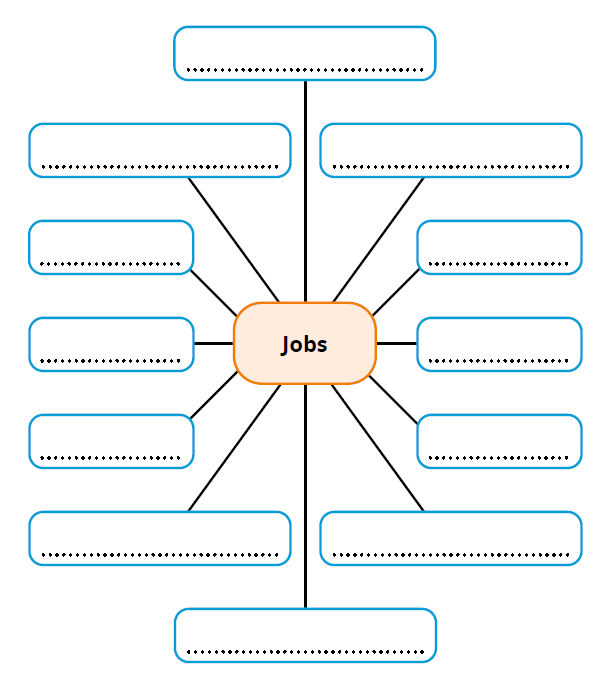
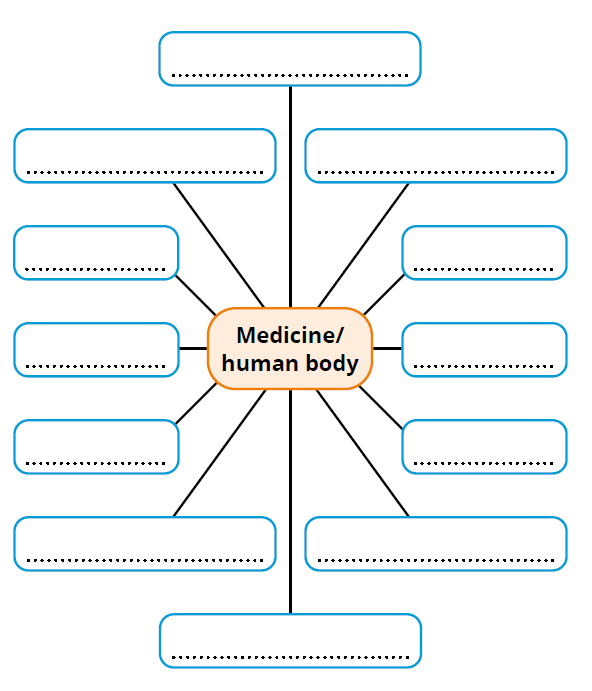
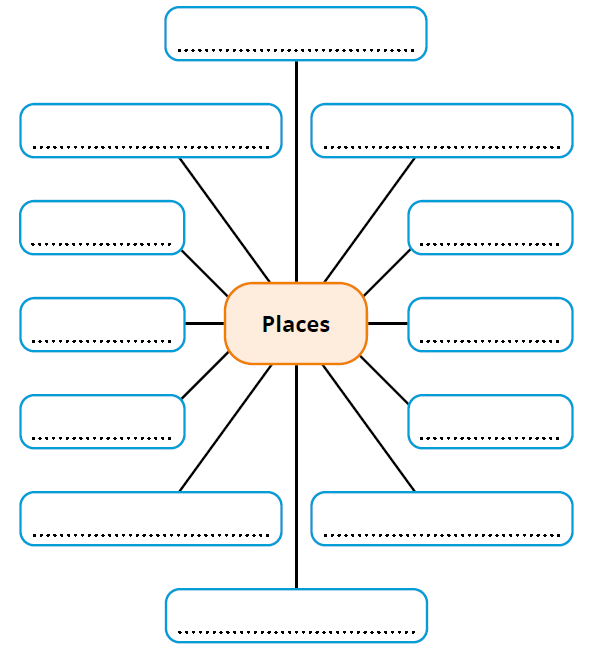
5.2. Look at the spidergrams. Complete them with nine words connected to each subject area. Use a thesaurus and a search engine.
6.
Practise the Answer short question task. Listen to the recordings. Answer the questions under test conditions.