Highlight Incorrect Words
July 8, 2024 2025-08-17 23:48Highlight Incorrect Words
Reading Time: 9 minutesPart 3: Listening
Highlight Incorrect Words
Made Easy
-
Type of recording: audio only (not video)
-
Length of recording: 15–60 seconds
-
Number of Incorrect Words: 5 - 6
-
Number of these tasks: 2 - 3
-
Total Listening Time: 20 - 23 minutes
Highlight incorrect words tests your ability to find differences between words you hear and words you read.
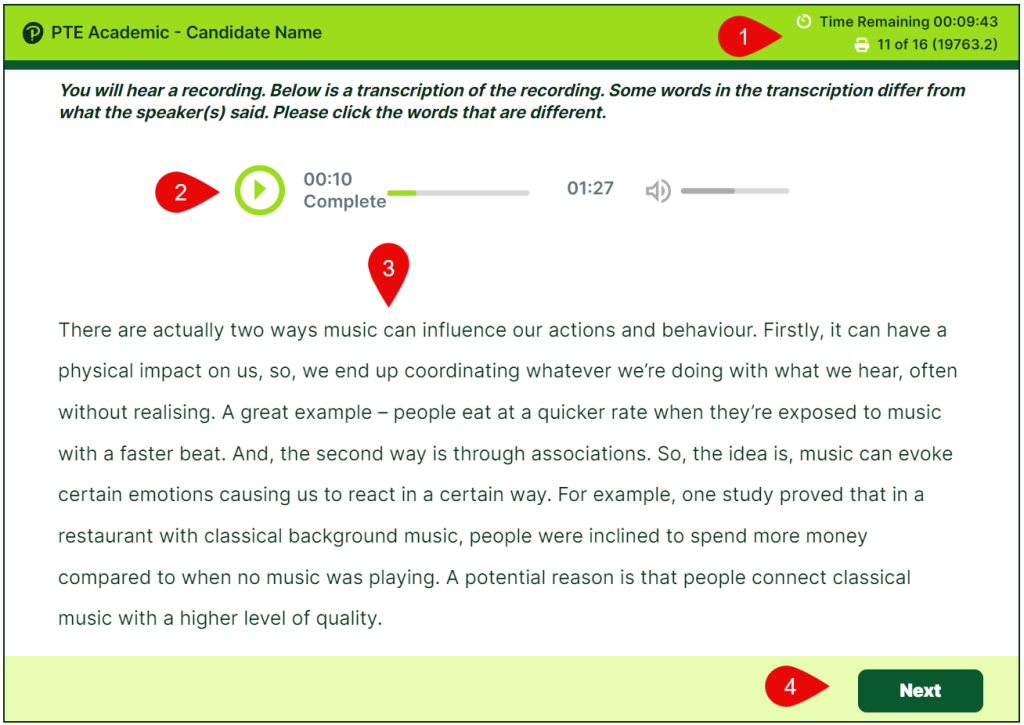
- You will see instructions, an audio status box and a transcript of a recording which has around five or six incorrect words.
- While listening to the audio (or after), click on the incorrect words.
- This task tests your listening and reading skills.
- A timer shows how much time is left for all the listening tasks in the test.
- The audio status box will count down from 10 seconds to zero, and then the audio will start.
- Click on the words in the transcript that are different from the words you hear. Note that only single words, not groups of words, are incorrect.
- Click ‘Next’ to go to the next question after you have checked your answer.
- PTE Academic - Candidate Name
- Time Remaining 00:09:43
- 11 of 16 (19763.2)
You will hear a recording. Below is a transcription of the recording. Some words in the transcription differ from what the speaker(s) said. Please click the words that are different.
There are actually two ways music can influence our actions and behaviour. Firstly, it can have a physical impact on us, so, we end up coordinating whatever we’re doing with what we hear, often without realising. A great example – people eat at a quicker rate when they’re exposed to music with a faster beat. And, the second way is through associations. So, the idea is, music can evoke certain emotions causing us to react in a certain way. For example, one study proved that in a restaurant with classical background music, people were inclined to spend more money compared to when no music was playing. A potential reason is that people connect classical music with a higher level of quality.
Highlight Incorrect Words Test Two Skills
-
Listeningup to 9 points
- Identifying errors in a transcript while listening
- Understanding and recognising the relationship between pronunciation and spelling
- Following oral sequencing of information
- Matching spoken text to writing
-
Readingup to 13 points
- Reading a text under timed conditions
- Identifying errors in a transcript while reading
- Understanding academic vocabulary
Top Strategies for Success in Highlight Incorrect Words
- Before The Test
Get used to listening to native speakers
Listen to speakers of English who have different accents from places such as New Zealand, Ireland, the USA, and so on. You will come across a variety of accents and dialects in the test, as all of the audio is from authentic sources.
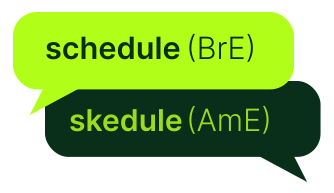
Improving your understanding of how different speakers pronounce words can help. For example, some words are pronounced differently in British and American English, such as the word schedule, which could sound like:
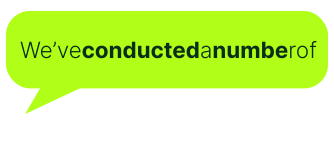
Get used to how speakers often say some groups of words faster than other groups, even in the same sentence. This is natural in English, but means you have to pay careful attention while following the transcripts.
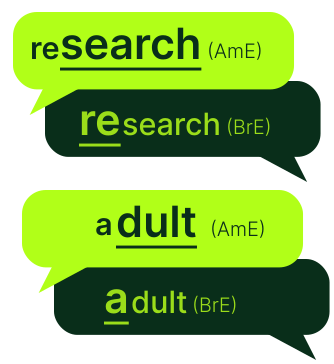
Pay attention to where word stress is placed differently by speakers from different countries. Try to learn differences like these:
-
Practice TipsFollow To Succeed
Find some podcasts on general topics similar to those you may study in school or at university, or academic lectures, that have transcripts. With these:
- Highlight all the key words in a short section of the transcript. Think about how they are pronounced and where the stress is placed within each word. Check this in a dictionary if you like.
- Then play the recording and read the transcript at the same time, checking if you were correct.
• Think about how the meaning of the extract would change if you changed any of the key words.
-
Language focus
Create lists of words from the recordings you use, with their synonyms, to expand your vocabulary. A thesaurus will help you to find new words with the same or similar meanings. When you learn a new word, record which syllable has the stress. Sometimes it’s easier to recognise a word by its stress pattern than by recognising the sounds that make up the word.
- During The Test
BEFORE LISTENING
Skim the transcript quickly to get a general idea of the topic. Don’t worry if you don’t have time to read every word – just get a sense of the topic and ideas.
Place your cursor at the beginning of the transcript just before the audio status box counter reaches zero, and get ready to follow the text with the cursor when the recording begins.
WHILE LISTENING
As soon as the recording starts, follow the words in the transcript as you listen with the cursor.
When you hear an incorrect word, click on it immediately, while continuing to follow the recording. Remember:
- words are highlighted in yellow when you click on them.
- they remain highlighted in yellow unless you click on them again.
- only single words should be highlighted, not groups of words. Incorrect words do not appear next to each other.
Keep following the speaker so you do not lose your place.
FINALLY
Click ‘Next’ to move on quickly – checking your answers is not realistic in these tasks.
AFTER LISTENING
Keep an eye on the timer and don’t spend too long on one listening task.
Remember, What To Do What Not To Do In Highlight Incorrect Words
- You should listen carefully to make your choices.
- You should not try to select words just because they look odd or wrong in the transcript, (e.g. unusual or long words).
- You should Choose a word only if you are sure it is different from the one you hear.
- You should not guess. You will lose points for each incorrect word you choose.
- You should keep reading as you listen.
- You should not lose track of the speaker, because it will be difficult for you to catch up and you may miss some of the other incorrect words.
- You should focus on the text while listening.
- You should not try to take notes. It’s difficult to pay attention to the transcript and erasable booklet at the same time.
- You should avoid going back to click on words.
- You should not change your mind unless you are sure you have made a mistake.
- You should choose 5–6 words (but don’t guess if you have fewer).
- You should not select too many words. You lose a point for each incorrect word. There should be around five or six words to highlight in each task.
- You should click on ‘Next’ when the audio has finished.
- You should not waste time checking your answers. Words have to be chosen while listening.
Practice Now With Your Trainer
Practise Highlight Incorrect Words 2 here if you want to try Highlight incorrect words without a time limit. Think about the strategies mentioned above. Then follow the task instructions.
- PTE Academic - Candidate Name
- Time Remaining 00:07:35
- 12 of 16 (19763.2)
You will hear a recording. Below is a transcription of the recording. Some words in the transcription differ from what the speaker(s) said. Please click the words that are different.
We’ve conducted a number of brain imaging studies on patients suffering from chronic pain, and found that we can predict, with great efficiency, who will respond to a placebo and who won’t. It basically comes down to their respective brain anatomies and physiological characteristics. In subjects whose pain was aggravated by the placebo, the right side of the brain—responsible for emotions and reward—was larger. Also, based on survey results, these high responders exhibited higher levels of emotional alertness and greater pain tolerance. This is great for the patients, as by using inactive drugs instead of active ones, you can avoid side effects like addiction, and also effectively minimise the expense involved.
Reflecting on your practice
1. Use the checklist below to decide what you did well and what you need to practise more. Set aside time to work on each area that you want to improve.
- I read the transcript and gained a general idea of the topic before listening.
- I clicked on up to five or six words I believed to be incorrect.
- I put my cursor at the beginning of the transcript just before the recording started.
- I could easily tell which words were different between the transcript and the audio.
- I followed the words in the transcript while listening.
- I only selected words I was reasonably sure of – I didn’t guess.
2. Check the answer given below. Was your answer correct? Try to think about how you could improve.
1. efficiency (word in audio is: efficacy)
2. physiological (word in audio is: psychological)
3. aggravated (word in audio is: alleviated)
4. alertness (word in audio is: awareness)
5. inactive (word in audio is: inert)
6. minimise (word in audio is: mitigate)
Common Mistakes Problems Errors In Highlight Incorrect Words
Points To Remember Listening Tasks
In some tasks you may only need to listen, whereas in others you will need to listen, read and then respond, or listen and then write. Make sure you know what skills you need to apply to each task type and practice them.
Listening items (apart from Summarize spoken text) are not timed individually. You will have between 20 to 23 minutes for all the listening items (excluding Summarizing Spoken Text). Make sure you practice managing your time effectively across all the tasks, to give yourself sufficient time to complete them
Quick Tips Strategies For Better Score!
In the 10 seconds before the recording begins, you cannot read word-for-word, but you can skim the transcription.
Focus on the words that give you information: e.g., nouns ('economy'), adjectives ('industrial'), and verbs ('manufactured'). Decide what the general topic is. This will help you pick out words that do not fit this topic area, as you read and listen:

In this item type, you have to select the wrong words as the text is read. Don't try to make notes as you listen.
Move the cursor along the screen as the words are spoken, and click on any words that sound different from the words on the screen:

Your response for Highlight Incorrect Words is judged on your ability to listen for - and to point out - the differences between a recording and a transcription.
Each selected word is scored as either correct or incorrect. If all the selected words are correct, you receive the maximum score points for this question type. If one or more selected words are incorrect, partial credit scoring applies.
This is the third of three question types where you can lose points if you choose any incorrect options. For any wrong options chosen, one point is deducted, while correct options are given one point. Make sure you are confident in your choices.
Notes
• This question type affects the scoring of listening and reading.
• Your speaking and writing skills are not tested by this question type.
• For more information download the Score Guide.