
Multiple Choice (Listening): Choose Multiple Answers
July 9, 2024 2026-05-07 19:52Multiple Choice (Listening): Choose Multiple Answers
Reading Time: 10 minutesPart 3: Listening
Multiple Choice (Multiple Answers)
Made Easy
-
Type of recording: audio or video, part of a lecture
-
Length of audio/video: around 50–90 seconds
-
Number of correct answers: 2 or more
-
Number of these tasks: 2 - 3
-
Total Listening Time: 20 - 23 minutes
Multiple Choice (Multiple Answers) tests your ability to understand the main ideas, detailed information, purpose, organisation, and inference in a short academic lecture or conversation.
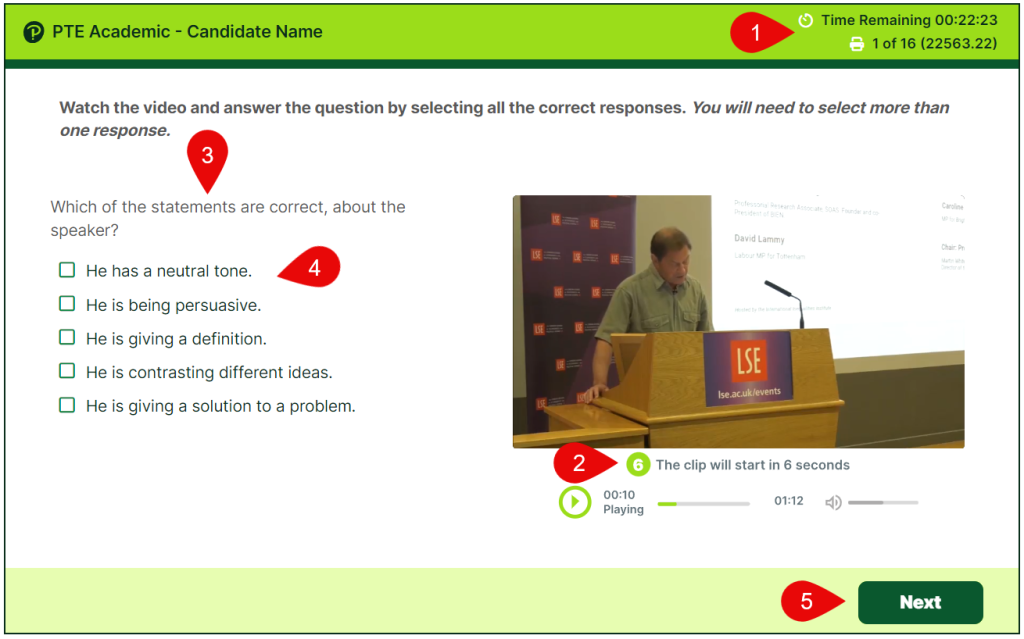
- You will see instructions, an audio status box and a multiple-choice question with 5 – 7 options to choose from.
- Read the question and options, listen to the recording, then choose at least two options you believe are correct.
- Only your listening skills are tested.
- The timer shows how much time is left for all the listening tasks in the test.
- In the audio status box, the status counts down from seven seconds to zero.
- While it counts down, quickly skim read the question and the options.
- Choose two or more options to answer the question. • To select an option, click on it. • To deselect an option, click on the option again.
- Click ‘Next’ to go to the next question after you have checked your answer.
- PTE Academic - Candidate Name
- Time Remaining 00:22:23
- 1 of 16 (22563.22)
Watch the video and answer the question by selecting all the correct responses. You will need to select more than one response.
Which of the statements are correct, about the speaker?
- He has a neutral tone.
- He is being persuasive.
- He is giving a definition.
- He is contrasting different ideas.
- He is giving a solution to a problem.
Multiple Choice (Multiple Answers) Tests Only One Skill
-
Listeningup to 4 points
- Identifying the main ideas and supporting points
- Identifying details, opinions, definitions or sequences
- Identifying the speaker’s purpose or attitude
- Making inferences from the information heard
- Inferring the meaning of unfamiliar words
- Comprehending explicit and implicit information
- Evaluating the quality and usefulness of texts
- Predicting how a speaker may continue
- Listening for organisation and connections between information
Top Strategies for Success in Multiple Choice (Multiple Answers)
- Before The Test
Staying confident while listening
It can be easy to panic when you don’t understand a speaker. Practise for this scenario by listening to sources of English which you find challenging. Use the following strategies.
Make sure you first understand what the topic is.
This will enable you to quickly decide what kind of thing you will hear. For example, if you know that the speaker is talking about a new government programme, it’s likely you’ll need to listen out for targets, cost, problems, etc. You can also look for topic clues in the task options.
Focus on the bigger picture.
Although this should normally be your priority when listening, with difficult audio tracks it’s especially important not to be distracted by less important details. Just listen out for the main ideas. An understanding of the bigger picture will often be enough to answer the question in this task
Try to pick out individual words or phrases and reconstruct them after the recording has finished.
For example if you pick out the words decreased, coffee and Ecuador, you could guess that coffee sales from Ecuador have decreased.
Listen to the speaker’s tone and intonation.
In this task, you might need to identify the attitude or purpose of a talk. This type of information can often be revealed through not only what a speaker says, but how they say it. A speaker’s tone can frequently show whether they are agreeing, disagreeing, questioning, expressing irony, providing evidence, summarising, and so on
-
Practice TipsFollow To Succeed
Listen to short sections of these lectures and identify the main points, along with any supporting details.
Practise making statements about the lectures you have found.
• Take a short section of the lecture (around 1 minute) and take notes on the speaker’s main ideas. Write down key words and use your own abbreviations or symbols. Then, stop the lecture and try writing a sentence summarising what you heard.
• Repeat this with another part of the lecture. However, this time, take notes on the speaker’s intention or purpose.
• Try to write some more statements about the lecture. This could be about the organisation and connection of ideas, detailed information, purpose, tone, etc. Listen to the lecture again and check your statements. Is there anything you can change to make them better or more accurate?
Try to find transcripts of the lectures (some universities have them).
• Go through them and identify the main points of the talk, any examples or evidence referred to and any opposing arguments. Highlight the signal words that indicate them (e.g. We need to focus on …, The issue here is …, What we’ve discovered is …, For instance, To illustrate, On the contrary, etc.). Then listen for them in the audio or video.
• Highlight any unfamiliar words in the transcript and guess their meaning from the words around them. Check your guess in a dictionary.
Create lists of words with their synonyms to expand your vocabulary. A thesaurus will help you to find new words with the same or similar meanings. When you learn a new word, record an example of how it’s used in context.
- During The Test
BEFORE LISTENING
Get your pen and erasable booklet ready.
Read the question carefully. It will tell you what type of information to listen for (e.g. main ideas, detailed information, inferences, speaker’s purpose or attitude, etc.). If it says, ‘How does the speaker link … ’, you will know to listen for relationships between ideas.
Look at the options very quickly. Just identify key words – that’s all you’ll have time for.
WHILE LISTENING
Listen carefully to the recording, keeping in mind the purpose for listening that you identified from the prompt.
- Take notes as you listen using your erasable booklet and pen. Use abbreviations, symbols and arrows to note the most important points and how they are connected.
- Listen for meaning and the flow of ideas. Don’t worry if you miss or don’t know some words – keep focusing on what you’re hearing.
- Keep looking at the options, if you can. Be careful, because most options will include some information that you hear, but only some are correct.
- Keep listening until the end, even if you think you have already heard the information you need. Sometimes speakers change what they’ve said or add extra information.
FINALLY
Refer to your notes again to check that the options you’ve chosen are correct. Change them only if necessary.
AFTER LISTENING
Read the question and the options again. Eliminate any option that seems clearly wrong (e.g. if it has incorrect information, or information not given). Then choose from the other options.
Aim to be clear in your mind about all the options. Think about why the ones you didn’t choose are incorrect, as well as why your chosen options are correct.
You may need to re-read the options and your notes several times before making a choice. If you’re not sure about an option, don’t choose it. You lose a point for each incorrect choice, so unlike Multiple-choice, choose single answer tasks, don’t guess! Keep an eye on the timer and don’t spend too long on one listening item.
Remember, What To Do What Not To Do In Multiple Choice (Multiple Answers)
- You should only make notes about important information.
- You should not try to take notes word for word.
- You should focus on the overall meaning of what you hear.
- You should not be distracted by unfamiliar words. Sometimes, focusing on words you don’t understand means you miss important details.
- You should choose options carefully.
- You should not select options you’re unsure about: in this task, you lose points for choosing incorrect options.
- You should decide using the information you hear.
- You should not make a decision based on the length or order of options, or because one option seems different.
- You should listen carefully before making a choice.
- You should not decide based on your personal knowledge.
- You should listen for meaning, not individual words.
- You should not simply match words with those you heard. Correct and incorrect options use the same words as in the audio or video.
- You should check all of the options.
- You should not make your final choices before checking all other options carefully.
- You should keep an eye on the timer.
- You should not spend too much time on one task.
Practice Now With Your Trainer
Practise Multiple Choice (Multiple Answers) 2 here, if you want to try Multiple-choice, choose multiple answers without a time limit. Think about the strategies mentioned above. Then follow the task instructions.
- PTE Academic - Candidate Name
- Time Remaining 00:20:11
- 2 of 16 (20563.22)
Listen to the recording and answer the question by selecting all the correct responses. You will need to select more than one response.
Which of these sentences about design thinking are likely to be correct, from what the speakers say?
- It is a quick way to solve problems.
- It works best with smaller companies.
- You should listen carefully to customers.
- It may be suitable for a software company.
- People generally find the process hard work.
- It is good to choose one idea and stay with it.
Reflecting on your practice
1. Use the checklist below to decide what you did well and what you need to practise more. Set aside time to work on each area that you want to improve.
- I read the prompt first and could identify what kind of information to listen for.
- I identified synonyms and paraphrasing rather than matching words.
- I could find the key words in the options before listening.
- I found relevant information from the recording/in my notes to support my chosen response.
- I could take notes of the main ideas and supporting details.
- I found reasons why the other options were incorrect.
- I used abbreviations and symbols in my notes to help write the ideas quickly.
- I only chose options if I was reasonably sure they were correct.
- I eliminated incorrect options.
- I checked my answers against my notes/memory before moving on.
2. Check the answers given below. Were your answers correct? Try to think about how you could improve.
1. Incorrect. As there are several steps in the process, and because they involve speaking with customers, making examples of the ideas, etc, it’s likely to take time.
2. Incorrect. While the man mentions that it’s popular with ‘young’ companies and these are likely to be smaller, at no point does anyone say it works best with younger companies. There are no other indications it works best with a particular type of company.
3. Correct: ‘speak to the people … usually your customers’, ‘ask them for feedback’ and ‘change your solution in light of feedback’ all imply listening carefully (there no point in speaking to customers unless you listen to what they say!)
4. Correct: The lady says ‘it’s suitable for a wide range of companies’.
5. Incorrect. While there may be lots of steps, at no point does anyone say anything that suggests difficulty or hard work.
6. Incorrect. The process involves lots of responding to feedback.
Common Mistakes Problems Errors In Multiple Choice (Multiple Answers)
Points To Remember Listening Tasks
Taking the time to get familiar with each listening task type is important. You only get to hear the recording once, so make sure you are always ready to listen with a clear goal in mind.
Listening items (apart from Summarize spoken text) are not timed individually. You will have between 20 to 23 minutes for all the listening items (excluding Summarizing Spoken Text). Make sure you practice managing your time effectively across all the tasks, to give yourself sufficient time to complete them
Quick Tips Strategies For Better Score!
In the seven seconds before the recording begins, read the question and get ready to take notes to help you answer. Taking notes is likely to be more helpful than trying to select options while you listen, because you may not hear the information in exactly the same order as the options.
Note down details (e.g., times, places, things that happened) as well as the main points, because you will need to select more than one option:

Select the options that best match the meaning of what you heard. Don't just choose an option because it has the same words or phrases as the recording. Several options may use words from the recording but may not match the meaning of what you have heard.

Your response for Multiple Choice, Multiple Answers is judged on your ability to analyze, interpret, and evaluate a brief audio or video recording on an academic subject. If all response options are correct, you receive the maximum score points for this question type. If one or more response options are incorrect, partial credit scoring applies.
Notes
• This question type affects the scoring of only listening.
• Your speaking and writing skills are not tested by this question type, and your reading skills are only used to read the instructions, prompt and response options.
• For more information download the Score Guide.