
Respond to a Situation
July 22, 2025 2026-01-13 19:21Respond to a Situation
Reading Time: 11 minutesPart 1: Speaking
RESPOND TO A SITUATION
Made Easy
-
Length of situation as text: 3–4 sentences
-
Preparation time: 10 seconds
-
Time to give response: 40 seconds
-
Type of recording: Description of a situation
-
Number of these tasks: 2 - 3
Respond to a Situation tasks test your ability to use functional
language appropriate to the context and situation.
- You will see instructions, a description of a situation, an audio status box and a recording status box.
- You will hear the description of the situation read out, so you can listen and read at the same time.
- You will have ten seconds to prepare before you have to start talking.
- This task tests your Speaking skills.
- The timer shows the time left for all tasks in this part of the test.
- Read the instructions.
- The audio status box counts down from 15 seconds to zero. Then the recording starts to play.
- Read and listen to the description of the situation.
- After the beep, the recording status box changes to ‘Recording’. Start speaking when the bar begins moving. When the bar reaches the end, the microphone switches off and the recording status box changes to ‘Completed’.
- Click ‘Next’ to go to the next task as soon as you’ve finished speaking.
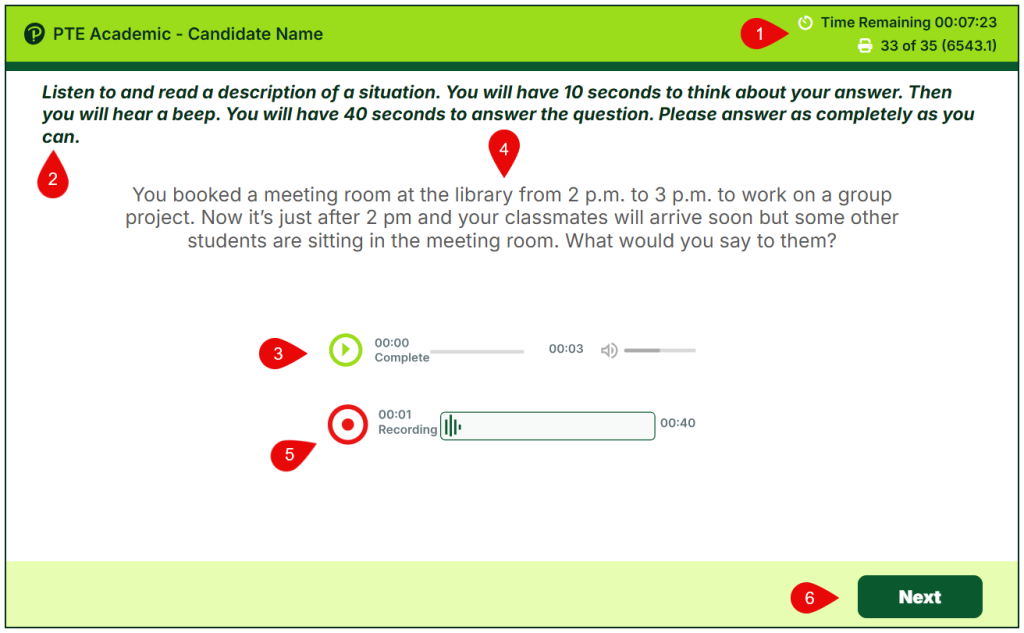
- PTE Academic - Candidate Name
- Time Remaining 00:07:23
- 33 of 35 (6543.1)
Listen to and read a description of a situation. You will have 10 seconds to think about your answer. Then you will hear a beep. You will have 40 seconds to answer the question. Please answer as completely as you can.
You booked a meeting room at the library from 2 p.m. to 3 p.m. to work on a group project. Now it’s just after 2 pm and your classmates will arrive soon but some other students are sitting in the meeting room. What would you say to them?

Respomd to a Situation Tests Only One Skill
-
Speakingup to 13 points
- Using appropriate functional language, e.g. apologising, making a request, persuading, etc.
- Using appropriate register, e.g. formal or informal, depending on the situation
- Using appropriate words, phrases and grammar
- Speaking fluently at a natural speed with correct intonation
- Using clear pronunciation
- Using an appropriate tone for the situation
Top Strategies for Success in Respond to a Situation
- Before The Test
Practise organising your descriptions into a logical structure.

INTRODUCTION
Start by addressing the person you would be speaking to in a direct way, e.g. Hi, sorry to bother you, but …

STATE YOUR PURPOSE
Explain why you are talking. Use the context from the description of the situation, e.g. I booked this room from two to three to work on a project with my classmates.

GIVE DETAILS
Add details, which are not included in the description of the situation, to show you communicate effectively, e.g. I saw on my way here that room 2 is free if you still need a room.

CALL TO ACTION
Finish your response with a call to action (e.g. make a request, ask for advice, apologise, etc.), which the description of the situation requires, e.g. Would you mind …?

TIME MANAGEMENT
Make sure your response is up to 40 seconds long.
-
Practice TipsFollow To Succeed
Generate ideas. Work with a friend to brainstorm situations and contexts in which you could ask for information, apologise, make
requests, ask for advice, etc. Try to think of formal and informal contexts. What would you say in such situations?
Record yourself. Set a 40-second timer and record your answer. Check afterwards the structure, your pronunciation, intonation and rhythm and general fluency. Check that you have included all important information and additional details and are comfortable completing the task within the 40-second time limit.
Practise changing generic terms into specific examples as quickly as you can. The situation description will often include generic terms, like group project or summer job. In your response, you should change them to specific examples, e.g. presentation on
19th century sculpture or lifeguard at a swimming pool rather than repeat words from the description. To help you come up with ideas quickly, try spotting generic terms in any content you see and then quickly coming up with a specific example.
Practise functional language. Whenever you read somewhere or hear someone asking for information, apologising, making a suggestion, etc., try to think of a different way to say the same thing. This will help you remember better a wider variety of expressions.
-
Language focus
Create useful functional language lists. Practise repeating those phrases as this will help you to quickly think of the right language to use for the situation.
- Make lists of language phrases for various purposes: asking for information, apologising, making suggestions, making requests, thanking, etc.
- Group the expressions on each language list under formal or informal.
Practise using synonyms. Your response will be better if you do not repeat word-for-word the words from the description of the situation.
- During The Test
WHILE LISTENING AND READING
Identify who you are addressing, the key words and purpose.
👉 Decide whether you need to use formal or informal language. Who are you talking to: a fellow student, a lecturer, someone you know, someone you don’t know?
👉 Identify the information that you should include in your response.
👉 Identify the purpose. Do you need to make a request, ask for information, give an apology and an explanation, etc.?
BEFORE RESPONDNG TO THE SITUATION
Quickly think of the details you need to include.
Remember, there is some information you need to include that may not be written in the prompt. For example, the
situation may require you to introduce yourself or give your contact details. Don’t give your real details! Make them up.
The situation description is also very generic and you need to add details to make it more specific.
There will be a beep to indicate when the microphone activates. Start speaking immediately after the beep.
FOLLOW A PLAN
• Describe the content of the image, e.g. The map shows …
• Summarise the most significant features with supporting details. For example, The highest temperature of 32 degrees was reached in the middle of summer, as seen in the graph in the month of July.
• Avoid repeating information.
• Pay attention to time and give your conclusion or implication before your 40 seconds of speaking time is finished.
Remember, What To Do What Not To Do In Respond to a Situation
- You only pause briefly.
- You don’t pause for longer than three seconds.
- You use your own words.
- You don’t simply repeat the words from the situation description.
- You speak with a natural speed. It’s fine to finish before the timer gets to zero.
- You don’t slow down just to fill the time.
- You should ignore others in the room.
- You don’t let other people speaking distract you.
- You use natural pronunciation.
- You don’t exaggerate your pronunciation or intonation. Speak as naturally as possible.
- You use natural pace and intonation.
- You don’t speak too fast or too slow or exaggerate your intonation.
Practice Now With Your Trainer
Practise Respond to a Situation 2 here, if you want to try the task without a time limit. Think about the strategies mentioned above. Then follow the task instructions and record your response on your mobile phone or other device.
- PTE Academic - Candidate Name
- Time Remaining 00:02:23
- 35 of 35 (2543.1)
Listen to and read a description of a situation. You will have 10 seconds to think about your answer. Then you will hear a beep. You will have 40 seconds to answer the question. Please answer as completely as you can.
You have applied for a summer job as a research assistant to your professor. You have not heard if your application was successful and need to check with your professor so that you can organise accommodation for the summer if necessary. You want to leave a phone message for your professor. What would you say?
Reflecting on your practice
1. Play back and listen to your response. Use the checklist below to decide what you did well and what you need to practise more. Set aside time to work on each area that you want to improve.
- I can prepare a response in ten seconds.
- I knew whether to use formal or informal language.
- I identified what information from the description I should include.
- I knew what additional details I should include, which are not mentioned in the description.
- I didn’t pause too much or for too long.
- I used appropriate intonation, rhythm and stress.
- I pronounced most words accurately.
- I spoke normally – not too loud, not too quiet, not too fast, not too slow.
- I didn’t pause too much and I didn’t miss out or repeat any words.
- I filled the time available and said everything I planned to say before the end
2. Listen to a model answer for this task. Compare it to your own response. What are the differences? Are you happy with your response? What could you improve?
Common Mistakes Problems Errors In Respond to a Situation
Points To Remember Speaking Tasks

Some speaking tasks require you to use language appropriate to the situation or context it is used in. In some tasks you may need to decide whether you need to use more formal or less formal language. It’s important to remember the register (formal or informal) of new words and grammar structures you learn, to make sure you use them appropriately.
Don’t click ‘Next’ too soon. Only move on to the next task when you are sure you are finished with the current one. You can’t go back to these tasks to try again.
More Questions on Respond to a Situation
1. Listen and read a description of a situation. You have 10 seconds to think about your answer. Then you will hear a beep. You will have 40 seconds to answer the question. Please answer as completely as you can.
Earlier today, your housemate offered you a portion of food she had cooked to take for lunch because you had a full day of university classes. You now want to express your gratitude for her generosity. It’s also made you want to learn about cookery from your housemate. What would you say to her?
2. Listen and read a description of a situation. You have 10 seconds to think about your answer. Then you will hear a beep. You will have 40 seconds to answer the question. Please answer as completely as you can.
You have been going to exercise classes at the gym on campus. You think your friend would find them genuinely enjoyable, motivating and beneficial but you suspect they won’t be keen on the idea. You’ve decided to try and persuade them to join you in the next session. What would you say to persuade them?
3. Listen and read a description of a situation. You have 10 seconds to think about your answer. Then you will hear a beep. You will have 40 seconds to answer the question. Please answer as completely as you can.
An older student has been a mentor to you over the last two years. During this time, your mentor has given you helpful guidance with your studies and personal development. You decide to thank your mentor and explain the positive impact their help and advice has had on you. What do you say?
4. Listen and read a description of a situation. You have 10 seconds to think about your answer. Then you will hear a beep. You will have 40 seconds to answer the question. Please answer as completely as you can.
Your university has promised you a single room in student accommodation on campus for this year. However, when you arrive at the room you’ve been assigned, you realise that it is a shared room. You decide to talk to the accommodation officer to explain what’s happened and politely insist on having a single room instead. What do you say?
Quick Tips Strategies For Better Score!
For this question type you need to listen to and read a prompt describing an everyday situation.
You then need to provide a spoken response describing what you would say in the situation.
You will have 10 seconds to think about your response, and then 40 seconds to speak.
The audio recording will play automatically.
After the audio finishes you will have 10 seconds to prepare.
The recording status box displays a countdown until the microphone opens. You will hear a short tone. After the tone, start speaking immediately. Do not start speaking before the microphone opens because your voice will not be recorded.
👉 You should speak clearly. There is no need to rush.
👉 Finish speaking before the progress bar reaches the end. The word “Recording” will change to “Completed”.
👉 You can only listen to the audio recording once.
👉 You can only record your response once.
Note: While the audio is playing you can take notes on the erasable whiteboard provided.
You have 10 seconds to prepare, so examine the prompt to decide what main points you will need to convey, and whether you will need to use a formal or informal register.
You only have 40 seconds to speak so make sure you are able to cover everything required by the prompt within the time allotted. Try to speak for the whole 40 seconds if you can. If you repeat ideas, correct yourself, or hesitate, you will use up valuable time and also lose score points. So, keep talking and ignore any mistakes that you make.
Your score is based on three factors:
Content: Is your response relevant to the prompt and does it convey prompt information accurately?
Content is scored based on whether you deal with the situation effectively and whether you communicate in a clear manner using appropriate expressions.
Be careful to respond to the situation using the information in the prompt. Do not miss out any key information or misinterpret the situation (e.g., if the situation says you need the slides by Friday but you say by Sunday - this is a misinterpretation). You should deliver your response using appropriate formal or informal language depending on the situation and who you are talking to.
Pronunciation: Does your response show you can produce speech sounds in a similar way to most regular English speakers?
Pronunciation is scored by assessing if your speech is easily understandable to most regular English speakers. The best responses contain vowels and consonants pronounced in a fluent-like way, and stress words and phrases correctly. Your answer should also be immediately understandable to a regular English speaker.
PTE recognizes regional and national varieties of English pronunciation to the degree that they are understandable to most regular English speakers.
Oral fluency: Does your response show a smooth, effortless and natural flow of speech?
Oral fluency is scored by assessing if your rhythm, phrasing and stress are smooth. The best responses are spoken at a constant and natural rate of speech with appropriate phrasing. Hesitations, repetitions and false starts will negatively affect your score.
Notes
• Partial credit scoring applies. No credit is given for no answer or an irrelevant answer.
• Your reading and listening skills are only used to read the instructions and to read and listen to the prompt.
• Content, Pronunciation and Oral Fluency are all Al- scored traits. A human expert will also review Content before your final score for the task is confirmed.
• For more information visit PTE Academic scoring page where you can download the Score Guide.