
Highlight Correct Summary
July 9, 2024 2025-08-18 0:49Highlight Correct Summary
Reading Time: 9 minutesPart 3: Listening
Highlight Correct Summary
Made Easy
-
Type of recording: audio only (not video)
-
Length of recording: 15–60 seconds
-
Number of Summaries: 4
-
Number of these tasks: 2 - 3
-
Total Listening Time: 20 - 23 minutes
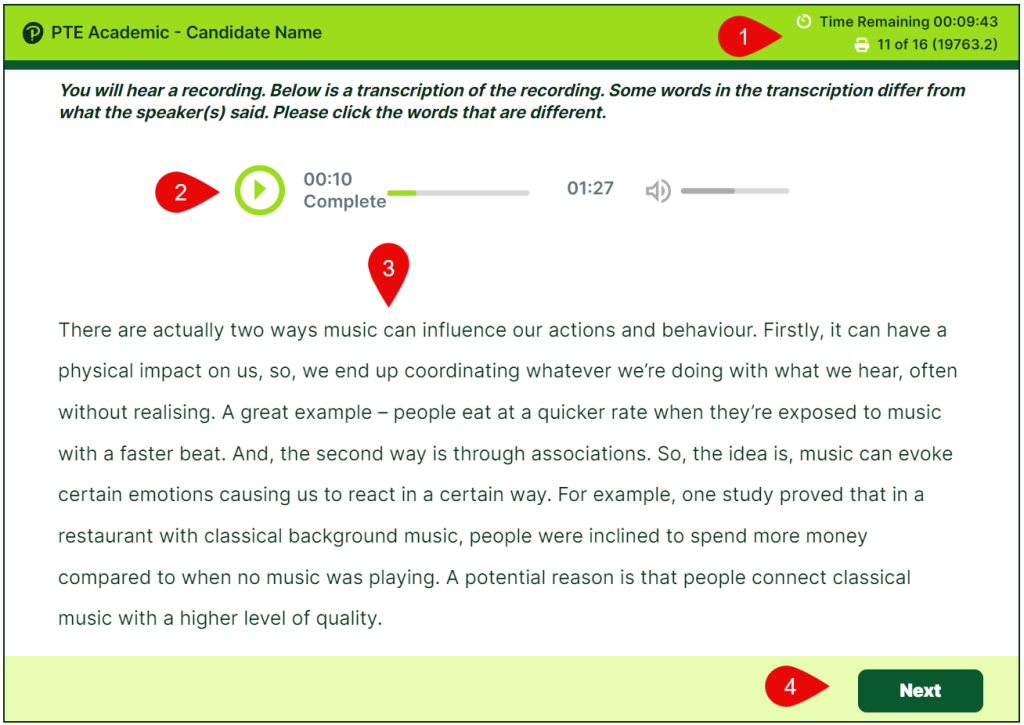
Highlight incorrect words tests your ability to find differences between words you hear and words you read.
- You will see instructions, an audio status box and a transcript of a recording which has around five or six incorrect words.
- While listening to the audio (or after), click on the incorrect words.
- This task tests your listening and reading skills.
- A timer shows how much time is left for all the listening tasks in the test.
- The audio status box will count down from 10 seconds to zero, and then the audio will start.
- Click on the words in the transcript that are different from the words you hear. Note that only single words, not groups of words, are incorrect.
- Click ‘Next’ to go to the next question after you have checked your answer.
- PTE Academic - Candidate Name
- Time Remaining 00:19:43
- 04 of 16 (24763.2)
You will see a video. Click on the paragraph that best relates to the video.
- After the age of twenty, teenagers start becoming more similar to adults. Their thinking processes change as their brains continue to develop over the next few years. The speaker suggests that brain training exercises can help young people to learn more languages.
- We have learnt that the brain develops until people are about twenty-five years old. Before this, adult and teenage brains process thinking differently. The speaker suggests that adults will go on learning if they use their brain to learn new skills.
- People do not stop physically being teenagers around the age of nineteen. Their brains continue to grow and learn for five more years in the same way as teenagers. The speaker suggests that exercising at the gym helps adult brains to develop new skills.
- When young people become twenty years old they become adults and are no longer influenced by strong feelings. Twenty-five is the age at which the speaker suggests that we need more physical exercise to stay healthy
Highlight Correct Summary Tests Two Skills
-
Listeningup to 2 points
- Identifying the gist, topic, main ideas and supporting points
- Identifying the speaker’s purpose, tone or attitude
- Inferring the meaning of unfamiliar words
- Classifying and categorising information
-
Readingup to 3 points
- Understanding explicit and implicit information
- Listening for overall organisation and connections between information
- Matching spoken information to written information
- Following a logical or chronological sequence
Top Strategies for Success in Highlight Correct Summary
- Before The Test
Eliminating false options
In Highlight correct summary tasks, it’s important to eliminate false options. Practise identifying them by thinking about their common characteristics.
HAVING A DIFFERENT MEANING
Sometimes whole sentences will directly contradict the original paragraph. However, in some cases it might only be a few words that are wrong. For example, everyone believes that… might be an incorrect summary compared to some people believe that … Check that the summary correctly represents the subject(s) and object(s); the time scale and sequence of events; the arguments for or against; the proportions and percentages, and so on..
PRESENTING ADDITIONAL INFORMATION
If a summary mentions details that were not in the recording, it will be incorrect. Sometimes it can be difficult to know whether information was mentioned. Therefore, it’s important to take notes while listening. For example, if the summary mentions nuclear and solar power, but you are sure you only heard about nuclear power and have no mention of solar power in your notes, the summary is likely to be incorrect.
FOCUSING ONLY ON DETAILS
If a summary fails to mention the main ideas of the recording, and talks only about the supporting points, it is an ineffective summary. For example, if the summary talks only about population growth, when the recording spoke about different effects of urbanisation, it is unlikely to be the correct summary.
-
Practice TipsFollow To Succeed
Find some podcasts or lectures (you may find some online) on serious or academic topics.
- Listen to around 30 seconds of the audio, taking notes of the main ideas. Then pause and write a summary sentence of what you heard. Practise this, using longer and longer extracts, until you can listen for 90 seconds and write a longer summary.
- Go back to your summary a few days later. Listen to the lecture again and check your summary. Is there anything you can change to make it better?
Practice reading quickly for general information. Find five paragraphs (approximately 50 words in each) from academic texts. Then try to read each paragraph in 10 seconds, in order to understand its general meaning. Then check your understanding by reading carefully.
-
Language focus
Find some transcripts of lectures (some university lectures or serious online sources will have these).
Read short extracts and identify the main points, along with any supporting details.
• Identify language that introduces a main idea or a supporting detail (e.g. We need to focus on …, The issue here is …, What we’ve discovered is …, For instance, To illustrate, On the contrary, etc.).
• Listen to the audio while reading the transcript. Notice how the speaker emphasises key words with stress or intonation. Underline these.
• You can also listen without reading. Make notes on what you hear and then check your notes against the transcript to see whether you noted down all the main ideas.
- During The Test
BEFORE LISTENING
Skim at least one of the four summaries very quickly, to get a general idea of the topic and main ideas. They will usually be on the same topic as the recording, so you don’t have to read them all to understand what the topic is.
Get your pen and erasable booklet ready
WHILE LISTENING
As you listen, take notes of the main ideas and supporting details using your erasable booklet and pen. Include, for example, any data used to support an idea or opinion, or any ideas that the speaker implies.
FINALLY
Check the remaining option or options against your notes, making sure your final choice accurately contains any main ideas and supporting information that was mentioned in the recording. Even if you are not sure which paragraph is the correct summary, choose the one that best matches your understanding of the recording. It is better to guess than leave this task unanswered.
AFTER LISTENING
After the recording stops, eliminate any paragraphs that:
- contain incorrect information;
- contain information that was not mentioned in the paragraph;
- only focus on details and not the main ideas.
Use your notes to help you, if you made any.
Remember, What To Do What Not To Do In Highlight Correct Summary
- You should use abbreviations, key words, symbols and other note-taking techniques of your own to get the main ideas.
- You should not try to write everything you hear.
- You should listen for meaning, not individual words.
- You should not be distracted by unfamiliar words. Focusing on words you don’t understand might mean you miss more important details.
- You should select an answer.
- You should not leave the task unanswered. Guessing is better than not answering if you are unsure.
- You should choose a summary based on the information you heard.
- You should not choose a summary just because you heard some of the word or ideas.
- You should listen carefully before deciding what to choose.
- You should not decide based on your own knowledge. Everything you need to know is in the recording.
- You should consider each summary carefully.
- You should not reject a summary just because you think there’s a grammar or vocabulary mistake in it. Summaries are carefully written so that they’re only incorrect because of the ideas they contain.
- You should keep an eye on the timer.
- You should not spend too much time on one task.
Practice Now With Your Trainer
Practise Highlight Correct Summary 2 here if you want to try Highlight correct summary without a time limit. Think about the strategies mentioned above. Then follow the task instructions.
- PTE Academic - Candidate Name
- Time Remaining 00:19:43
- 04 of 16 (24763.2)
You will hear a short lecture. Click on the paragraph that best relates to the recording..
- The Mediterranean diet consists mainly of plant-based foods and smaller amounts of fish and meat. It is believed that these foods, combined with regular exercise, can result in improved heart and brain health as well as extended lifespan, although there is the possibility that the people following this kind of diet are generally health-conscious anyway.
- There is substantial evidence that the Mediterranean diet, combined with a consistent exercise plan, can offer a number of health benefits such as a longer lifespan and protection against heart disease. This diet favours plant-based foods, and it is recommended that foods containing fats, such as olive oil and fish, shouldn’t be used excessively.
- Based on the foods typically eaten in countries like Spain and Greece, the Mediterranean diet is considered beneficial with regard to extending one’s lifespan and maintaining a healthy heart and brain. Preferred foods include fruits and vegetables, nuts and beans, and various kinds of fish. Meats are included in small amounts, with white meat usually preferred over red meat.
- Experts recommend moving towards a Mediterranean diet along with regular exercise in the interest of improving heart health, brain function and generally improving the ageing process. It is thought that by making small changes in a typical diet, such as adding more fish or increasing healthy fats, one can eventually be rewarded with superior health and a longer lifespan.
Reflecting on your practice
1. Use the checklist below to decide what you did well and what you need to practise more. Set aside time to work on each area that you want to improve.
- I could skim at least one summary and gained a general idea of the topic before listening.
- If I really didn’t know the answer, I made the best possible guess.
- I used note-taking techniques (e.g. abbreviations, symbols) while listening AND/OR I could read the summaries while listening and get an idea of which were bad and which were good.
- I checked my choice, to make sure it had main ideas as well as supporting information from the recording.
- I eliminated summaries because they had missing or incorrect information, or missed out the main ideas from the recording.
2. Check the answer given below. Was your answer correct? Try to think about how you could improve.
- Correct: ‘… foods such as vegetables, wholegrains, um beans, fruits, nuts…’, ‘…consumption of animal protein is generally on the lower side, fish does feature prominently…’, ‘…beneficial effect on heart health, and this diet has been linked in numerous studies with not only that, but also improved brain function and longer life expectancy.’, ‘…it is often the combination of these specific nutrients, teamed with regular physical activity…’, ‘it may also just be that the people who eat a Mediterranean Diet are those that tend to have a healthier lifestyle in general.’
- Incorrect: Contradictory information: Speaker states that healthy fats are emphasised (not that they ‘shouldn’t be used excessively’) due to their perceived beneficial effects on heart health.
- Incorrect: Information not mentioned: speaker does not mention white versus red meat.
- Incorrect: Contradictory information: Speaker states that small, simple additions like these to the current diet are insufficient for gaining the benefits associated with the Mediterranean diet.
Common Mistakes Problems Errors In Highlight Correct Summary
Points To Remember Listening Tasks
Be prepared to be flexible with your ideas while you listen. Sometimes it’s easy to think you have identified all the key information after the first part of the recording, but you might change your mind later on. Always listen carefully until the end.
Listening items (apart from Summarize spoken text) are not timed individually. You will have between 20 to 23 minutes for all the listening items (excluding Summarizing Spoken Text). Make sure you practice managing your time effectively across all the tasks, to give yourself sufficient time to complete them
Quick Tips Strategies For Better Score!
Don't read the options before or while you are listening to the recording as there is too much to read, and this will distract you. Instead, note down the key ideas on your erasable note-board booklet as you listen (e.g., key words and phrases, numbers, names and dates and any information that is highlighted by the speaker through stress and intonation).
Then read the options and match the option that is closest in detail to your notes:

Your response for Highlight Correct Summary is judged on your ability to comprehend, analyze, and combine information from a recording and identify the most accurate summary of the recording. Your response is scored as either correct or incorrect. No credit is given for no response or an incorrect response.
Notes
• This question type affects the scoring of listening and reading.
• Your speaking and writing skills are not tested by this question type.
• For more information download the Score Guide.