
Multiple Choice (Reading): Choose Multiple Answers

Multiple Choice (Reading): Choose Multiple Answers

Reading Time: 11 minutes
Part 2: Reading

Multiple Choice (Multiple Answers)

Made Easy

  • Length of text: up to 300 words
  • Correct responses 2 or more
  • Number of these tasks: 2 - 3
  • Total time for all tasks: 29 - 30 minutes

Multiple Choice (Multiple Answers)  tests your ability to understand the main ideas, detailed information, purpose, organisation, and inference in a short academic text.

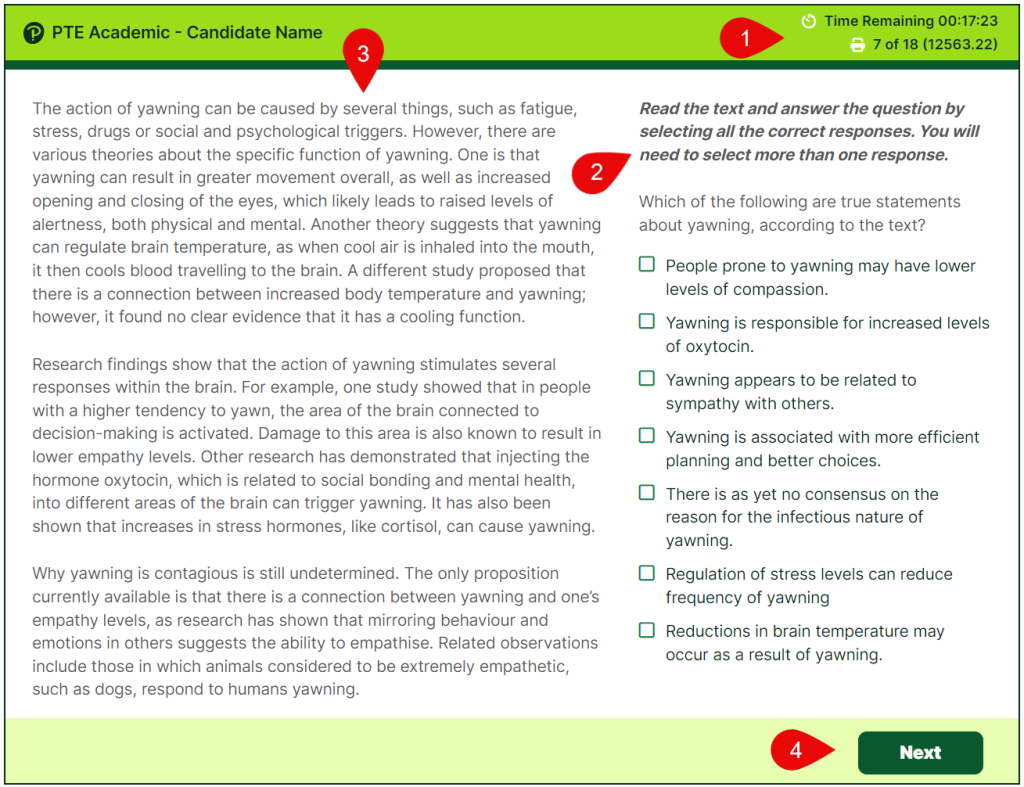
The action of yawning can be caused by several things, such as fatigue, stress, drugs or social and psychological triggers. However, there are various theories about the specific function of yawning. One is that yawning can result in greater movement overall, as well as increased opening and closing of the eyes, which likely leads to raised levels of alertness, both physical and mental. Another theory suggests that yawning can regulate brain temperature, as when cool air is inhaled into the mouth, it then cools blood travelling to the brain. A different study proposed that there is a connection between increased body temperature and yawning; however, it found no clear evidence that it has a cooling function.

Research findings show that the action of yawning stimulates several responses within the brain. For example, one study showed that in people with a higher tendency to yawn, the area of the brain connected to decision-making is activated. Damage to this area is also known to result in lower empathy levels. Other research has demonstrated that injecting the hormone oxytocin, which is related to social bonding and mental health, into different areas of the brain can trigger yawning. It has also been shown that increases in stress hormones, like cortisol, can cause yawning.

Why yawning is contagious is still undetermined. The only proposition currently available is that there is a connection between yawning and one’s empathy levels, as research has shown that mirroring behaviour and emotions in others suggests the ability to empathise. Related observations include those in which animals considered to be extremely empathetic, such as dogs, respond to humans yawning.

Read the text and answer the question by selecting all the correct responses. You will need to select more than one response.

Which of the following are true statements about yawning, according to the text?

  • Reading
    up to 5 points

Top Strategies for Success in Multiple Choice (Multiple Answers)

This task tests two key ways of reading.

Skimming

AIM: to find the main ideas of the text

With short texts, read the first and last sentence of each paragraph quickly to get the main idea of what they are about.

With longer texts, skim through the introduction and conclusion.

Scanning

AIM: to search for specific details in a text (e.g. names, numbers, key words)

You do this without reading every word. Look for key words that relate to the information you are searching for. This is particularly useful for multiple choice tasks where you will often need to find key details quickly.

  • Practice Tips
    Follow To Succeed

Practise by looking at short texts from serious books or magazines. Find some texts (2–5 paragraphs) and then do the following:

• Find ideas in the texts and think about what the relationships are between then. Ask yourself, ‘What conclusions can be drawn?’
• Practise locating topic sentences, which can help you to identify the main message. Topic sentences are sometimes the first sentence of a paragraph, and help to introduce the paragraph’s main idea.
• Identify cohesive devices. For example, highlight a word like this or it and then the idea it refers to. Or find a word for an idea that’s repeated and then highlight each synonym of that word to follow the idea through the text.

Allow time to practise these tasks while working within a time limit. Try not to spend more than 2–3 minutes on each of these tasks.

Expand your vocabulary by creating lists of words with their synonyms. A thesaurus will help you to find new words with the same or similar meanings. When you learn a new word, record an example of how it’s used in context.

Deal with unfamiliar words by doing the following.
• Check if the word is actually explained in the text somewhere.
• Try to guess what it means from the context.
• Decide if you really need to understand the word. If not, ignore it.

FIRST

Read the question carefully. It will tell you what to look for in the text (e.g. if it says, Which of the following purposes …, you will know to read to identify the writer’s purpose).

Read the options. Identify key words and think about the differences between the options.

NEXT

Quickly skim the text to get the general idea. Then read it carefully, according to the purpose you identified from the

FINALLY

Read the text again to check the options you’ve chosen are correct.
• Compare each of the other options to the text to check they are incorrect.
• If you change your mind, click on the option again to de-select it.

THEN

Ignore any option that seems clearly wrong after reading the text.
Choose options that seem the most likely to be correct.
Try to decide why your chosen options are correct.
• If the question is asking about detailed information, find the part of the text that shows your chosen options are correct.
• If the question refers to more general ideas in the text, quickly re-read it to check that your chosen options are correct.
• If you can’t find any good evidence for your options, select different options and repeat this process.
• You may see words and phrases in the text that are the same in an option. This doesn’t mean this option is correct. Read the text carefully and make sure you are clear about the meaning and how it relates to the option.
• Think about why the options you didn’t choose are incorrect.

Answer the question by clicking on more than one option.
If you’re not sure about an option, don’t guess. You lose a point for each wrong choice.

Check how much time you have and don’t spend too long on one reading task

Remember, What To Do What Not To Do In Multiple Choice (Multiple Answers)

Practise Multiple Choice (Multiple Answers) 2 here, if you want to try Multiple-choice, choose multiple answers without a time limit. Think about the strategies mentioned above. Then follow the task instructions.

When making decisions, we tend to be heavily influenced by the first piece of information that we come across, which we then, often unknowingly, use as a reference or ‘anchor’ point. Psychologists have learned that once this occurs, we tend to be biased toward processing any other information we obtain based on the anchor, which in turn impacts on our decisions. A simple example is when we choose to purchase an item, such as a computer, and we learn what the typical price for it is. Anything lower than that seems reasonable, and we may subsequently end up paying an amount based on that initial figure, even if it is more than what the computer is really worth.

Research has shown that even seemingly unrelated information can result in us making incorrect estimates. In one study, participants chose random numbers, which then influenced their attempts to answer questions on unrelated topics, like how many African countries were in the UN. The anchoring effect, also known as focalism, can impact our decisions in a variety of areas. In addition to price estimates, salary negotiations are another prime opportunity for this bias. Studies have shown that the person who makes the initial offer has an advantage as that amount becomes the anchor point for all subsequent discussions. This could work to one’s benefit, as starting with an inflated salary request may lead to a higher result than otherwise anticipated.

Nevertheless, we must remain aware of the potential drawbacks of this bias. Medical practitioners, for instance, may be overly influenced by first impressions of a patient or information in their records, which could result in inaccurate diagnoses.

Read the text and answer the question by selecting all the correct responses. You will need to select more than one response.

Which of the following points does the writer make about anchoring?

1. Use the checklist below to decide what you did well and what you need to practise more. Set aside time to work on each area that you want to improve.

2. Check the answers in the Answer key. Were your answers correct? Try to think about how you could improve.

1. Incorrect: This is not stated: ‘Anything lower than that seems reasonable, and we may subsequently end up paying an amount based on that initial figure, even if it is more than what the computer is really worth.’ There is no mention of whether this leads to exceeding budgets or not.

2. Correct: ‘Medical practitioners, for instance, may be overly influenced by first impressions of a patient or information in their records, which could result in inaccurate diagnoses.’

3. Incorrect: This is contradicted by the text: ‘… the person who makes the initial offer has an advantage as that amount becomes the anchor point for all subsequent discussions. This could work to one’s benefit, as starting with an inflated salary request may lead to a higher result than otherwise anticipated.’

4. Incorrect: This is contradicted by the text: ‘The anchoring effect, also known as focalism …’

5. Incorrect: This is not stated: ‘… when we choose to purchase an item, such as a computer, and we learn what the typical price for it is. Anything lower than that seems reasonable, and we may subsequently end up paying an amount based on that initial figure, even if it is more than what the computer is really worth.’

6. Correct: ‘In one study, participants chose random numbers, which then influenced their attempts to answer questions on unrelated topics, like how many African countries were in the UN.

Common Mistakes Problems Errors In Multiple Choice (Multiple Answers)

Reading tasks are not timed individually. You will need to manage your time effectively in this section of the test in order to complete all the tasks within the overall time for the Reading section.

The reading section of the test has 13-18 tasks that you need to complete. When you are satisfied with your response for a task, click ‘Next’ to move on to the next one.

Quick Tips Strategies For Better Score!

Read the instructions carefully. Remember that more than one option is correct in this type of multiple-choice item. You will score marks for any correct options but you will lose score points for any incorrect options.

These include options that you have clicked on as correct but which are wrong. If you click on all the options because you do not know the answer, you will lose score points. This applies to Multiple Choice, Multiple Answers item types for reading and listening.

Quickly read through the response options and note any words that are repeated, particularly adjectives (e.g., 'multigrade') or nouns (e.g., 'classes'). If the same noun phrase occurs in a lot of the options, the answer is probably related to this phrase.

Scan the text for the repeated words. Then read around them to find the answer more quickly:

Your response for Multiple Choice, Multiple Answers is judged on your ability to analyze, interpret and evaluate a short reading text on an academic subject. If all responses are correct, you receive the maximum score points for this question type.

If one or more response options are incorrect, partial credit scoring applies.

This is the first of three question types where you can lose points if you choose any incorrect options. For any wrong options chosen one point is deducted, whilst correct options are given one point. Make sure you are confident in your choices.

Note
• This question type affects the scoring of reading.
• Your listening, speaking and writing skills are not tested by this question type.
• For more information download the Score Guide.