
Select Missing Word

Select Missing Word

Reading Time: 8 minutes

Part 3: Listening

Select Missing Word

Made Easy

  • Type of recording: audio or video, part of a lecture
  • Length of audio/video: around 20–70 seconds
  • Number of correct answer: 1
  • Number of these tasks: 1 - 2
  • Total Listening Time: 20 - 23 minutes

In Select missing word tasks, you can use clues from a recording to predict the last word or group of words. This requires an understanding of the overall meaning of the recording.

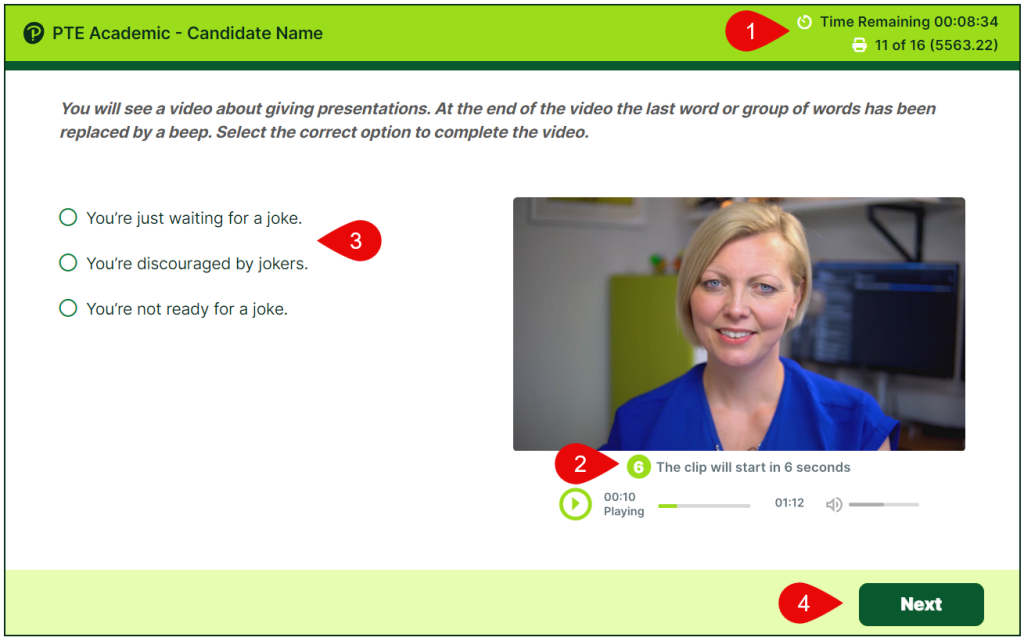
You will see a video about giving presentations. At the end of the video the last word or group of words has been replaced by a beep. Select the correct option to complete the video.

  • Listening
    up to 1 point

Top Strategies for Success in Select Missing Word

Decide whether you want to take notes in this task.

Try listening to short audio extracts (30–60 seconds long) with and without note-taking, pausing, and then predicting the next few words. Which way was easier?

NOTE-TAKING

Note-taking allows you to list all the main points of the recording, without overlooking any ideas. After the recording ends, you might spot things in your notes that you hadn’t realised while listening.

If note-taking:
• only note down key words. You don’t need to write down specific details.
• skim the options before and while listening. Then compare the options with your notes after listening.

LISTENING & VISUALISING

Alternatively, just listening might allow you to focus more on how the recording flows towards the missing words.

If just listening:
• try to produce a mental map of what you hear. Visualise the subject and the flow of ideas.
• think about the options while listening, comparing them to what you have visualised.

  • Practice Tips
    Follow To Succeed

Find some examples of podcasts or lectures (you may find some online) on serious or academic topics. Avoid news sources, as these are not usually similar to what you will hear in the test. Try to find ones with transcripts.

  • Look at the transcript and highlight any linking words that introduce examples, evidence or contrasting arguments.
  • Listen to the audio and listen for the words you highlighted. Notice how the linking words signal a change in the direction of the talk.

Practise brainstorming vocabulary quickly. First, look for a piece of audio online and read the title. In 30 seconds, brainstorm all the vocabulary you can think of which you might hear in the recording. Then listen and check if any of the words are used.

Generally, it’s a good idea to practise predicting the ideas and vocabulary you will hear in a piece of audio or in a video. You can also play a short extract of audio, stop it and then predict what you might hear next. Continue playing to check your ideas.

Expand your vocabulary by identifying words from the podcasts or lectures that you want to learn. Check if the speaker uses any synonyms of these words and record them. When you record new words, try to do so in an example sentence, to show the context it’s used in

BEFORE LISTENING

Read the instructions, as the first sentence mentions the topic. Knowing the topic before listening will help you identify the main ideas more quickly.

Skim the options very quickly, just to get a quick sense of their meaning.

WHILE LISTENING

Listen carefully for the main points and flow of ideas in the talk – these will help you more than the details in these tasks.

Pay attention to any signal words that might suggest the purpose of the next sentence or sentences. For example, they might give opposite arguments (e.g. on the other hand), describe something in detail (e.g. if we look carefully, …) or support an opinion (e.g. because). This helps you spot if the direction of the talk changes just before the end.

Focus on the options, if you can. Be careful, because most options will relate in some way to the recording, but only one is correct.

Focus as much as possible on the last part of the recording, so that you hear the words immediately surrounding the beep.

FINALLY

Check your memory of the recording and your answer option to make sure everything is consistent.

Click ‘Next’ to move on quickly to the next task.

AFTER LISTENING

Think about what would come next in the recording. Then, read the options carefully.

  • Eliminate any option that seems wrong (e.g. the information is the opposite of what you expected, or it is on the right topic but says something irrelevant to the rest of the recording).
  • From the remaining options, choose the one that has the closest meaning to what you expect.
  • Aim to be clear about all the options. Think about why the ones you didn’t choose are incorrect, as well as why your chosen option is correct.
  • You may need to re-read the options (and your notes, if you took any) several times.
  • Even if you are not sure which answer option is correct, choose one that feels the most suitable. It is better to guess than leave the task unanswered.

Keep an eye on the timer and don’t spend too long on one listening task.

Remember, What To Do What Not To Do In Select Missing Word

Practise Select Missing Word 2 here, if you want to try select missing word without a time limit. Think about the strategies mentioned above. Then follow the task instructions.

You will hear a recording about marketing. At the end of the recording the last word or group of words has been replaced by a beep. Select the correct option to complete the recording.

1. Use the checklist below to decide what you did well and what you need to practise more. Set aside time to work on each area that you want to improve.

2. Check the answers given below. Were your answers correct? Try to think about how you could improve.

research and planning (‘persuading’ wasn’t mentioned; ‘designing’ is done by others on marketers’ advice, not by the marketers themselves; the speaker was talking about what marketers do other than ‘selling’ and advertising).

Common Mistakes Problems Errors In Select Missing Word

The audio and video recordings in these tasks are designed to test English only. You don’t need any special knowledge. It doesn’t matter if you are unfamiliar with the subject. All the information you need to complete the task is in the recording

Listening items (apart from Summarize spoken text) are not timed individually. You will have between 20 to 23 minutes for all the listening items (excluding Summarizing Spoken Text). Make sure you practice managing your time effectively across all the tasks, to give yourself sufficient time to complete them

Be careful not to click ‘Next’ too soon. You can’t go back to these tasks to try again.

Quick Tips Strategies For Better Score!

For each item in this task, there are three to five response options but only ONE option is correct. At the end of the recording, click on the option you think is correct.

The next recording does not begin playing until you click 'Next'. So you have a little time to think about your answer. If you want to change your answer, click on it again to 'de-select' it. Then click on the option you think is correct.

Your response for Select Missing Word is judged on your ability to predict what a speaker will say, based on contextual clues in a recording. Your response is scored as either correct or incorrect. No credit is given for no response or an incorrect response.

Note
• This question type affects the scoring of only listening.
• Your speaking and writing skills are not tested by this question type, and your reading skills are only used to read the instructions and the response options.
• For more information download the Score Guide.