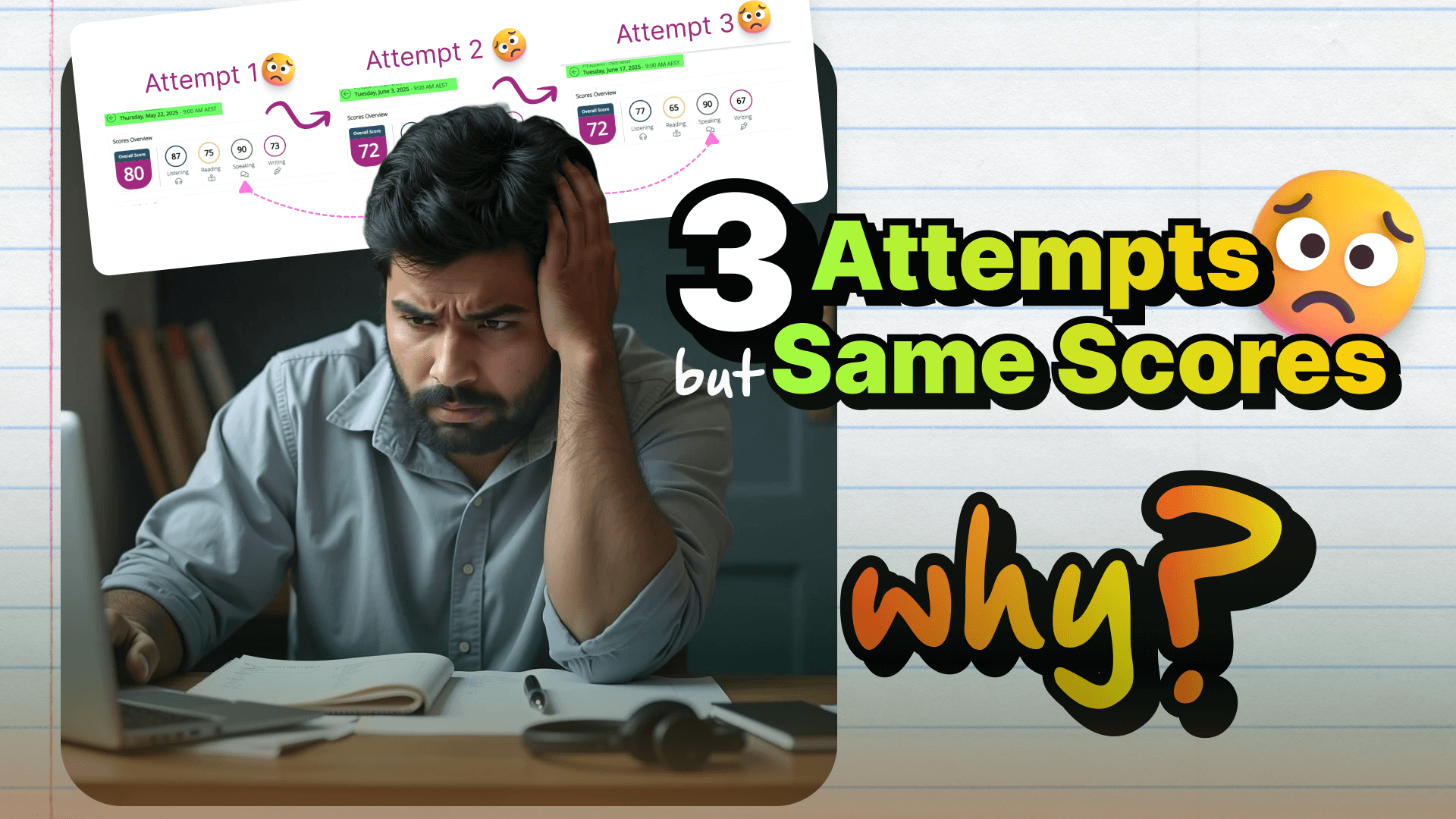
Hello everyone, this is Hafiz, your PTE Academic Prep. Mentor. Over my ten years of coaching, I’ve seen a recurring, frustrating pattern. A dedicated student, often needing that magic score of 79+ for their visa or professional registration, finds themselves stuck. They take the test again and again, only to see the same disappointing numbers in Reading and Writing, leaving them feeling demotivated and questioning their abilities.
It’s a scenario that breaks a student’s confidence, especially when one part of their score looks perfect. They might be scoring a flawless 90 in Speaking, attempt after attempt, yet the doors to their dreams remain closed by a stubborn 65 in Reading or 67 in Writing.
Today, we’re going to do something different. We won’t just talk about generic tips. We will dive deep into a real-life case study of a student in Australia who faced this exact challenge in May and June of 2025. By analyzing their three scorecards and my detailed breakdown, you will not only see their mistakes but also understand the precise, strategic changes required to overcome them. This isn’t just a story of failure; it’s a roadmap to your success.
The Case Study Breakdown: A Story of Stagnation
Let’s meet our student. For the sake of this analysis, we’ll call him David. David is aiming for 20 permanent residency points in Australia, and for that, he needs to achieve a superior score of 79+ in all four PTE modules. However, his journey has been a rollercoaster of frustration.
Here’s a look at his three recent attempts in 2025:
| Attempt Date | Listening | Reading | Speaking | Writing |
| May 22, 2025 | 87 | 75 | 90 | 73 |
| June 3, 2025 | 72 | 69 😢 | 90 | 68😢 |
| June 17, 2025 | 77 | 65😢 | 90 | 67😢 |
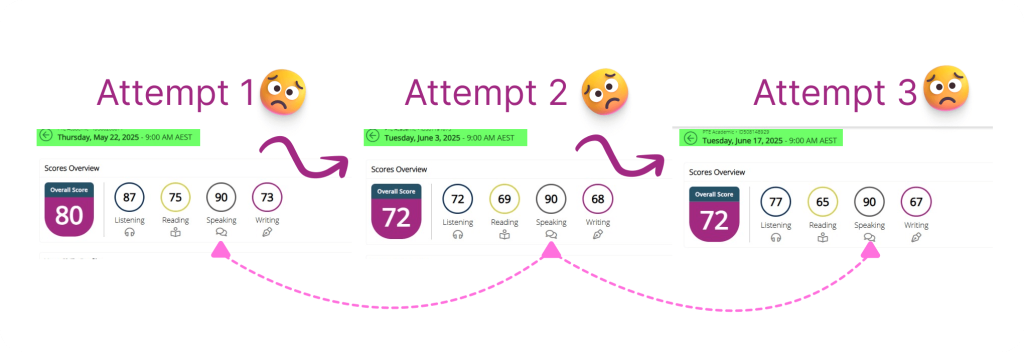
After his third attempt, David was completely demotivated. He told me, “Hafiz, I don’t get it. I got 90 in Speaking three times! I improved my Listening score. But my Reading and Writing scores are going down. Is it just bad luck?”
This feeling of helplessness is the biggest enemy of a PTE test-taker. David was convinced he was doing everything right, but the scores told a different story. He was trapped in a cycle of repeating the same errors, hidden behind the deceptive glare of a perfect Speaking score.
Mistakes Identified: The Real Story Behind the Scores
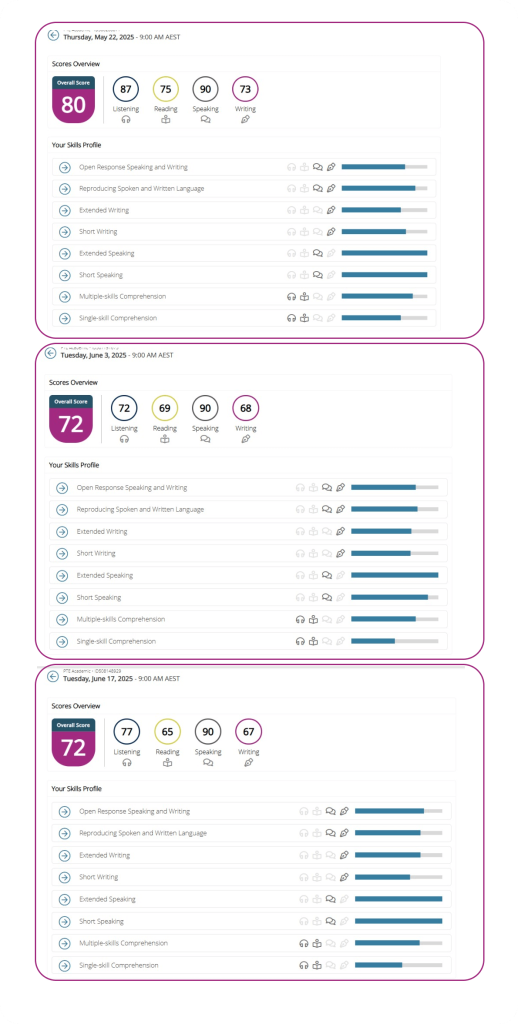
A PTE scorecard is more than just four numbers. The real gold is in the Skills Profile. A surface-level look shows a student who is excellent at speaking. But a deeper analysis reveals the critical flaws holding him back.
1. The Overconfidence Trap of a 90 in Speaking
This is the most common and dangerous trap. For years, students from the South Asian subcontinent have known that the key to a high speaking score is fluency—speaking continuously without hesitation. This is true, and it gets you a 90. But here’s the harsh reality: a 90 in Speaking does not mean your speaking technique is helping your other scores.
David was so happy with his 90 that he never thought to critique his performance in the speaking section. The problem lay in Read Aloud. While he was fluent, his delivery wasn’t providing the maximum possible points to his Reading score.
2. Misunderstanding the Integrated Scoring Algorithm
PTE is not four separate tests; it’s one integrated exam.
- Read Aloud gives points to Speaking AND Reading.
- Summarize Written Text gives points to Writing AND Reading.
- Repeat Sentence & Write from Dictation give points to Speaking/Writing AND Listening.
- Reading & Writing: Fill in the Blanks gives points to Reading AND Writing.
David’s skill profile showed a weakness in “Open-response speaking/writing,” which directly points to Read Aloud and Summarize Written Text. Though he got 90 in speaking, he lost at least 10-15 points for his Reading score from his Read Aloud performance alone.
3. Neglecting the Real Culprits in Reading and Writing
David’s skill profile was a clear confession of his weaknesses:
- Single Skill Comprehension (Reading Fill in the Blanks): His score was barely 50 out of 90. This task is heavily dependent on vocabulary, collocations, and grammar. He was likely guessing based on what “sounds good” rather than knowing the answer.
- Multiple Skill Comprehension (Reading & Writing: Fill in the Blanks): Similar to the above, he had significant room for improvement. These questions heavily impact both Reading and Writing scores.
- Short Writing: This was the biggest culprit for his low Writing score. This skill is primarily assessed through Write from Dictation and Listening: Fill in the Blanks. His performance was poor, hovering around 60 out of 90, indicating numerous spelling mistakes and missed words. He was losing a potential 15+ marks for his Writing and Listening scores right here.
- Extended Writing (Essay): While not disastrous, his score here wasn’t at a 79+ level, suggesting issues with grammar, vocabulary range, or spelling.
4. Repeating the Same Mistakes Without Analysis
The most telling part of David’s scorecard comparison between June 3rd and June 17th was the similarity in the skill profile. His performance in “Open-response speaking/writing” and “Short writing” was almost identical in both tests.
This proves it wasn’t bad luck. He used the exact same methods, the same templates, and the same flawed techniques, and predictably, he got the same results. He was stuck in the 65-70 range because his fundamental approach was unchanged.
A Quote from Hafiz
“Stop and ask yourself two questions: What mistakes did I make in my last attempt? And what am I doing differently now to fix them? If you don’t have clear answers, you are not ready for your next test. It’s not about luck; it’s about rectifying your errors.”
Hafiz’s Detailed Suggestions: Your Blueprint for a 79+ Score
So, how do we fix this? It requires a strategic shift away from blind practice towards targeted improvement. Here’s the action plan I gave David.
Focus Area 1: Revolutionize Your Read Aloud for the Reading Score
Forget that you have 90 in Speaking. Your new goal for Read Aloud is not just fluency, but clarity and contribution to Reading.
- Stop Rushing: Speak at a natural, clear pace. Don’t try to sound like a robot or a news anchor.
- Focus on Keywords: Ensure you are pronouncing the key nouns, verbs, and adjectives clearly. The Pearson algorithm picks these up to award Reading points.
- Practice with a Purpose: Record yourself. Listen back. Are you stumbling? Is your pronunciation of complex words clear? Use AI-based practice platforms, but with caution—prioritize feedback from an expert trainer who understands the scoring.
Focus Area 2: Master Summarize Written Text & Essay
Your Writing score depends heavily on these tasks.
- Summarize Written Text (SWT): Stop just picking two random sentences and joining them with “and.” You MUST identify the two main ideas of the passage. If your summary misses the main points (i.e., your content score is low), your entire score for the task can plummet. Learn to use complex sentence structures with connectors like “while,” “although,” or a semicolon.
- Essay: Use a proven template for structure, but focus on developing your arguments with relevant examples. The biggest score killers here are spelling and grammar. Proofread your practice essays relentlessly. Ensure you are using a good range of vocabulary and grammatical structures (e.g., compound, complex sentences).
Focus Area 3: Dominate the Fill-in-the-Blanks
This is non-negotiable for a 79+ in Reading.
- Reading & Writing: Fill in the Blanks (Dropdowns): This tests grammar and collocation. Practice 20-30 questions daily from reliable sources. Don’t just check the answer; understand why a particular option is correct. Create a vocabulary notebook for new collocations you learn (e.g., “financially dependent,” “critically acclaimed”).
- Reading: Fill in the Blanks (Drag & Drop): This tests context and vocabulary. The strategy here is elimination. Find the easiest blank to fill first. This reduces your options and makes the harder blanks easier to solve. Again, daily, focused practice is key.
Focus Area 4: Perfect Your ‘Short Writing’ Skills
This is where David was losing a huge chunk of his Writing and Listening points.
- Write from Dictation (WFD): This is the final, and one of the most important, tasks. Practice 50 WFD questions daily. Focus 100% on spelling. Even a single letter error can cause you to lose marks. Type the sentence, then proofread it carefully before clicking next.
- Listening: Fill in the Blanks: Similar to WFD, spelling is critical. Be prepared for plural ‘s’, ‘ed’ endings, and common homophones.
The Right Preparation Roadmap: Your 4-Week Turnaround Plan
Feeling overwhelmed? Don’t be. Here is a step-by-step plan to structure your preparation.
💡 Step 1: Honest Evaluation (Week 1)
Take a full, timed Pearson Scored Mock Test. This is non-negotiable. Don’t rely on third-party portal scores, which I have found to be up to 90% inaccurate in their qualitative judgment. Record your entire screen and voice during the mock test.
💡 Step 2: Expert Analysis (Week 1)
This is where you bring in an expert. Sit down for a one-on-one coaching session to analyze your mock test result and the screen recording. A certified trainer can pinpoint exactly where you hesitated in Read Aloud, which spelling errors you made in WFD, and why your SWT content score was low.
💡 Step 3: Targeted Practice (Weeks 2 & 3)
Your daily practice should now be focused, not random.
- Daily Speaking (30 mins): 15 Read Alouds (focusing on clarity), 15 Repeat Sentences (focusing on accuracy).
- Daily Writing (45 mins): 2 Summarize Written Texts, 1 Essay. Get these evaluated for grammar, spelling, and content.
- Daily Reading (60 mins): 15 Reading & Writing FIBs, 15 Reading FIBs. Review every single mistake.
- Daily Listening (45 mins): 2 Summarize Spoken Texts, 50 Write from Dictations.
💡 Step 4: Final Polish & Review (Week 4)
One week before your exam, take a second Pearson Mock Test. Compare the skill profile with your first one. Have your weak areas improved? This is the data that tells you if you are truly ready to get 79+. Spend the final week polishing your strategy and reviewing your mistake log.
Internal Link Suggestion: For more detailed strategies on acing the listening module, check out our comprehensive guide on How to Score 90 in PTE Listening.
What Students MUST Avoid at All Costs
- Blind Retakes: Never book another test without a new, improved strategy. You are just wasting your money and crushing your own morale.
- Relying Only on Speaking: Don’t let a high speaking score make you complacent. It is often hiding the root cause of your problems in Reading and Writing.
- Ignoring the Skill Profile: Your overall scores are vanity; your skill profile is the reality. Learn to read it and understand what it’s telling you.
- Panicking: The difficulty of questions can vary. Some days you might get easier Fill-in-the-Blanks passages. You can’t rely on that luck. A solid, skill-based preparation is the only thing that will work every time.
Your Journey to 79+ Starts Now
I understand the pressure you are under. The story of David is the story of thousands of students who feel lost. But the key takeaway is this: it’s not about how many times you fail; it’s about whether you are willing to change your method.
You are not stuck at 65 or 70. You are at that level because your current methods produce that result. Change the method, and you will change the result.
Are you tired of seeing the same frustrating scores? Are you ready to finally understand what’s holding you back and get a clear, personalized plan for success?
Send us your most recent PTE Scorecard on WhatsApp at +61423017055. Let’s put an end to the guesswork.
We are offering a free 20-minute 1-on-1 Zoom session where I will personally analyze your report and show you the exact areas you need to fix.
Don’t forget to follow our YouTube channel for regular tips, live classes, and success stories.
Conclusion: Success is a Matter of Strategy, Not Chance
David’s story doesn’t have to be your story. Your dream of getting 20 points for PR in Australia or achieving the score for your professional goals is within reach. It requires honesty about your weaknesses, a commitment to targeted practice, and guidance from someone who understands the intricate details of the PTE scoring system.
With the right help and a smart strategy, your next PTE attempt can be your last. Let’s make it happen together.